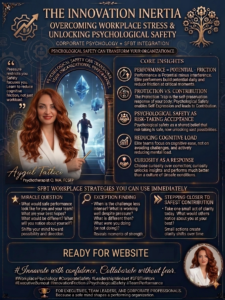
Succeed Without Burning Out
Psychology | Psychotherapist Aygul Tatlici
Let’s Slow This Down for a Moment
Because if you’re like many high-performing professionals I work with, you don’t struggle with knowing what to do.
You struggle in that moment…
When everything you know feels just slightly harder to access.
You’re about to speak.
Lead.
Decide.
And something shifts internally.
Your body tightens.
Your thinking speeds up.
Your attention turns inward.
You start watching yourself.
Evaluating.
Adjusting.
And without realizing it…
You’ve stepped out of performance—and into self-monitoring.
Now stay with me here.
Because this moment?
It’s not failure.
It’s information.
What’s Really Happening at Work
We often assume workplace stress comes from:
Too much work
Too many demands
Not enough time
And yes—that’s part of it.
But underneath all of that…
There is a quieter question your system keeps asking:
“Is it safe for me to fully show up here?”
This is what Amy Edmondson described as psychological safety—
The sense that you can speak, contribute, and even make mistakes without fear of negative consequences (Edmondson, 1999).
And when that feels uncertain…
Something very human happens.
You don’t stop performing.
You start protecting.
You:
Hold back ideas
Overthink your words
Avoid taking risks
Try to “get it right”
And slowly…
That protection turns into pressure.
The Hidden Shift: From Contribution to Protection
There’s a simple way to understand this:
Your ability doesn’t disappear under pressure.
It gets covered.
Covered by:
Overthinking
Second-guessing
Managing how you’re perceived
Trying to avoid mistakes
So when you feel “off” at work…
It’s not that you’re less capable
It’s that you’re carrying too much internally at once
Why Feeling Safe Changes Everything
Research has shown something powerful:
The most effective teams are not the ones that avoid mistakes.
They are the ones who feel safe enough to:
Speak early
Ask questions
Admit uncertainty
Recover quickly
Because when you feel safe:
You think more clearly.
You act more freely.
You stay connected to what you know.
Let’s Bring This Back to You
Take a moment and reflect—gently, without judgment.
When do you feel most like yourself at work?
When do you:
Speak more freely?
Think more clearly?
Act without overthinking?
And then ask yourself:
“What feels different in those moments?”
Because those moments matter.
They show you something important:
You already have access to the version of you that performs well.
The goal isn’t to “become” someone else.
It’s to remove what gets in the way of who you already are.
Now let’s look a little closer at what happens internally.
In pressured moments, your mind may say things like:
“This needs to go perfectly”
“What if I get this wrong?”
“They might judge me”
“I should have done better”
And if you notice carefully…
These thoughts don’t feel neutral.
They feel urgent.
Heavy.
Convincing.
But here’s something important to hold onto:
Not every thought you have is a fact.
Many are simply attempts to protect you.
They’re trying to help you avoid risk.
But in doing so…
They often increase pressure.
A Softer Shift That Changes Everything
Instead of asking:
“Why am I like this?”
Try something more useful:
“What helps me stay connected to myself—even under pressure?”
Because that version of you already exists.
Think of a recent moment where:
You handled something well
You stayed present
You didn’t spiral into overthinking
Now gently explore:
What were you focusing on?
The task—or yourself?
The outcome—or the process?
Contributing?
These small differences matter more than you think.
When Your Mind Jumps to the Worst Outcome
Pause for a moment and ask:
“Is this the only possible outcome?”
“What else could also be true here?”
Then gently test it in reality.
Often, what you fear feels bigger than what actually happens.
When You Start Over-Preparing or Overthinking
Notice the urge to:
Rehearse repeatedly
Double-check everything
Wait until it feels “just right”
And instead, try this:
Leave a small part unfinished
Speak without over-polishing
Let yourself experience that:
You can handle things—even without perfect preparation.
When You Feel Stuck or Drained
Instead of waiting to feel motivated…
Try:
Taking one small, meaningful step anyway
Send the message
Start the task
Join the conversation
And notice how:
Movement creates energy—not the other way around.
Instead of carrying the pressure silently…
Try asking:
“What matters most here?”
“What would a good outcome look like?”
Clarity reduces pressure more than effort ever will.
Now let’s gently shift your attention toward the future.
Not with pressure.
But with curiosity.
Ask yourself:
“If I felt more at ease at work, how would I show up differently?”
“What would I say more of—and what would I stop holding back?”
“How would I act if I trusted my ability a little more?”
“What kind of environment helps me feel calm, focused, and clear?”
“What does ‘doing well’ look like for me—not just to others?”
And maybe the most important one:
“What would change if I didn’t need to prove anything—only contribute?”
Sit with that.
Because your answers to these questions…
Quietly shape how you begin to show up.
A Small Practice You Can Use Today
The next time you feel that familiar moment—
The tightening
The pressure
The overthinking
Pause.
And ask:
“What matters most right now?”
And gently return your attention there.
You may notice:
A little more space
A little more clarity
That’s not random.
That’s you coming back to yourself.
You don’t need:
Perfect confidence
Zero anxiety
Complete certainty
To perform well.
You only need:
To stay connected to what matters
To take small actions—even when it feels uncomfortable
To loosen the grip of pressure—not eliminate it
Because your ability hasn’t disappeared.
It’s still there.
References (APA Style)
Beck, J. S. (2011). Cognitive behavior therapy: Basics and beyond (2nd ed.). Guilford Press.
Beilock, S. L., & Carr, T. H. (2001). On the fragility of skilled performance. Journal of Experimental Psychology: General, 130(4), 701–725.
Clark, D. A., & Beck, A. T. (2010). Cognitive therapy of anxiety disorders. Guilford Press.
Dietrich, A. (2004). Neurocognitive mechanisms of flow. Consciousness and Cognition, 13(4), 746–761.
Edmondson, A. (1999). Psychological safety and learning behavior. Administrative Science Quarterly, 44(2), 350–383.
Gallwey, W. T. (1974). The Inner Game of Tennis. Random House.
Maslach, C., & Leiter, M. P. (2008). Burnout and engagement. Journal of Applied Psychology, 93(3), 498–512.
Rozovsky, J. (2015). The five keys to a successful Google team. Google Re: Work.
Subscribe for monthly updates on mental health tips, therapy insights, and wellness strategies.
Stay connected with our community and receive valuable resources to support your mental health journey.
Fill out the form below and I'll get back to you within 24 hours.
Coaching is not psychotherapy; coaching does not diagnose or treat mental health conditions. Coaching focuses on personal development, goal achievement, and mindset shifts. It is not a substitute for a serious mental health treatment, diagnosis, or psychotherapy.