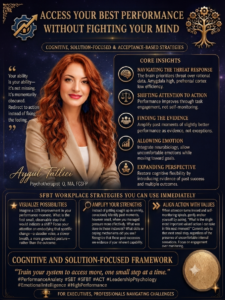
If you’ve ever been in that moment—right before something important—and felt your body tighten, your thoughts speed up, your confidence dip… you’ve probably wondered what’s going on with you.
There is nothing wrong with you.
Your brain is doing exactly what it was designed to do—protect you. When it detects potential evaluation or risk, it activates survival circuitry. Attention narrows, your body prepares, and your thinking becomes biased toward possible threats (LeDoux, 1996; Clark & Beck, 2010).
That’s when thoughts show up:
“What if I mess this up?”
“What if they notice?”
“What if this goes badly?”
And they don’t feel like guesses. They feel real.
But those thoughts might have been shaped by predictable cognitive distortions—patterns first identified by Aaron T. Beck—such as catastrophizing, mind-reading, and overestimating risk (Beck, 2011).
When your mind jumps to the worst-case scenario… has it actually always turned out that way?
Or is that just the version your brain highlights the most?
Even highly successful people experience this.
Before major presentations, Steve Jobs was known to feel intense pressure and anxiety. What made the difference wasn’t eliminating those thoughts—it was where he placed his attention. He focused on what he wanted to share, not how he might be judged (Isaacson, 2011).
So consider this:
What actually matters to you in those moments?
What do you want to contribute?
Now think of a time—just one—where you handled something slightly better than expected.
Not perfectly. Just better.
What was different?
What were you focused on?
What helped, even a little?
That moment matters.
Because it shows you already have access to what you need.
Change grows from identifying and expanding what is already working (de Shazer et al., 2007).
What are you already doing that helps you get through this?
You might also notice something frustrating.
Even when you know your thoughts are not fully accurate… your emotional response is still strong.
That’s not failure.
Emotional systems activate faster than logical reasoning, which is why feelings can persist even when you “know better” (LeDoux, 1996).
And if expressing emotions wasn’t encouraged in your earlier environment, you might also feel something else—shame about the anxiety itself.
So instead of trying to eliminate the feeling, try shifting your relationship with it.
What if the goal is not to feel different first… but to move forward with the feeling present?
Meaningful action can happen alongside discomfort (Hayes et al., 2012).
Now imagine your next performance situation.
Things go just 10% better.
What’s the first small sign?
Are you a bit more focused?
A bit less in your head?
A bit more connected to what you’re doing?
And what would you be doing differently to create that?
When that moment comes and you feel the shift—
Pause.
And ask yourself:
“What is the next small step I can take right now?”
Then take it.
Not perfectly. Just intentionally.
Afterward, notice:
What went slightly better than expected?
What helped you continue?
This is how your brain updates its predictions—through real evidence, not pressure (Beck, 2011).
You don’t need to eliminate anxiety to perform well.
You don’t need perfect confidence.
You don’t need complete certainty.
You need to stay connected to what matters… and take small steps, even when it feels uncomfortable.
your ability hasn’t disappeared.
It’s still there.
And every time you show up, you’re strengthening access to it.
So let me leave you with this:
If you trusted yourself just a little more in that moment—
What would you do?
Beck, J. S. (2011). Cognitive behavior therapy: Basics and beyond (2nd ed.). Guilford Press.
Clark, D. A., & Beck, A. T. (2010). Cognitive therapy of anxiety disorders: Science and practice. Guilford Press.
de Shazer, S., Dolan, Y., Korman, H., Trepper, T., McCollum, E., & Berg, I. K. (2007). More than miracles: The state of the art of solution-focused brief therapy. Routledge.
Hayes, S. C., Strosahl, K. D., & Wilson, K. G. (2012). Acceptance and commitment therapy: The process and practice of mindful change (2nd ed.). Guilford Press.
Isaacson, W. (2011). Steve Jobs. Simon & Schuster.
LeDoux, J. (1996). The emotional brain: The mysterious underpinnings of emotional life. Simon & Schuster.
Subscribe for monthly updates on mental health tips, therapy insights, and wellness strategies.
Stay connected with our community and receive valuable resources to support your mental health journey.
Fill out the form below and I'll get back to you within 24 hours.
Coaching is not psychotherapy; coaching does not diagnose or treat mental health conditions. Coaching focuses on personal development, goal achievement, and mindset shifts. It is not a substitute for a serious mental health treatment, diagnosis, or psychotherapy.