Let’s slow this down for a moment
Because if you’re like most high-performing professionals I work with, you don’t struggle with knowing what to do.
You struggle in that moment…
when everything you know seems just slightly harder to access.
You’re about to speak.
Lead.
Decide.
And something shifts internally.
Your body tightens.
Your thinking speeds up.
Your attention turns inward.
You start watching yourself.
Evaluating.
Adjusting.
And without realizing it…
you’ve stepped out of performance—and into self-monitoring.
Now stay with me here.
Because what I’m about to say may feel surprisingly relieving:
That moment is not a problem.
It’s actually the entry point to better performance.
The Equation That Changes How You See Yourself
There’s a simple model from performance psychology:
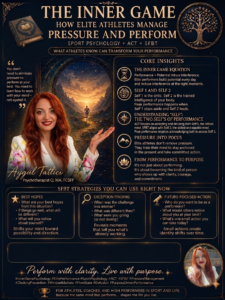
Performance = Potential – Interference
(Gallwey, 1974)
Let’s make this real.
Your potential is already built:
That’s not disappearing under pressure.
What is showing up… is interference:
So when you feel “off”…
you’re not losing ability.
You’re experiencing too much internal involvement.
Why This Matters ?
Most people respond to this moment by trying to:
And that… actually increases interference.
So instead, we take a different route.
Redirection.
A Shift You Can Feel Right Now
Just take a breath for a second.
And think about something coming up for you—
a real situation.
Now imagine yourself in it.
And notice…
What does your mind want to do?
Speed up?
Prepare everything?
Get it right?
Good.
Now gently ask yourself:
“What is the one thing that matters right now?”
Not everything.
Just one.
And as you find that one thing…
Notice what happens in your body.
There’s usually a small shift.
A little more space.
A little less pressure.
That’s not accidental.
That’s you reducing interference—in real time.
What Science Says Is Actually Happening — And How You Can Use This Knowledge
When you overthink under pressure, your brain shifts into a state of increased conscious monitoring.
The part of your brain responsible for analysis, planning, and control—the prefrontal cortex—becomes highly engaged.
After all, your ability to think, analyze, and solve problems is one of the reasons you have achieved what you have achieved.
But here is the interesting part:
The same mental system that helps you prepare can sometimes interfere when you are already prepared.
Because your best performance often does not come from thinking harder.
It comes from allowing the knowledge, skills, and experience you have already built to become available.
Research on expertise and flow suggests that highly skilled performance depends on automatic processes developed through repetition and experience (Dietrich, 2004).
Think about something you do well.
Maybe leading a meeting.
Having a difficult conversation.
Making a decision.
Presenting an idea.
Driving a familiar route.
You do not consciously tell yourself every single step.
You trust a system that has already learned.
But under pressure, something interesting can happen.
You start watching yourself.
“Am I saying this correctly?”
“Do they think I am competent?”
“What if I make a mistake?”
“Am I performing well enough?”
And suddenly, instead of being fully engaged in the moment…
part of your attention moves toward evaluating yourself.
This is what researchers describe as choking under pressure—when conscious control begins interfering with skills that normally operate effectively (Beilock & Carr, 2001).
But here is the important part:
This is not evidence that you are incapable.
It is evidence that you care.
It is evidence that the moment matters.
And the skill is not learning how to eliminate pressure.
The skill is learning how to return your attention to what matters most.
Let’s Make This Practical
I want you to think about a recent moment when you experienced this.
Maybe it was:
Take a moment and ask yourself:
“When does my mind tend to become louder than my experience?”
Is it when:
And now consider this:
“What does my mind usually try to protect me from in those moments?”
Because often, overthinking is not your enemy.
It is your brain attempting to help.
It is saying:
“Let me make sure this goes well.”
“Let me prevent mistakes.”
“Let me prepare you.”
The intention is protection.
The challenge is that sometimes protection becomes interference.
A Solution-Focused Shift
Instead of asking:
“Why do I overthink?”
Try asking:
“When am I able to stay connected to my ability, even under pressure?”
Think of a time when you handled a difficult situation well.
Maybe you were nervous.
Maybe there was uncertainty.
Maybe the outcome mattered.
But something worked.
What was different about that moment?
Were you:
What did you do that allowed your capability to show up?
Because that is the part we want to strengthen.
Not by creating a new version of you.
But by making it easier to return to the version of you that already exists.
A Small Practice for Your Next High-Pressure Moment
The next time you notice your mind becoming busy, experiment with this:
Instead of saying:
“I need to calm down.”
Try:
“My system is preparing me. Now, where do I want to place my attention?”
Then ask:
“What matters most in this moment?”
Not:
“What could go wrong?”
Not:
“How am I being evaluated?”
But:
“What is the next useful thing I can do?”
Maybe it is:
Your attention is like a spotlight.
Where you place it shapes your experience.
I want you to consider this:
The goal is not to become someone who never feels pressure.
The goal is to become someone who recognizes pressure—and knows how to return.
So ask yourself:
“If I trusted my preparation 10% more, what would I do differently?”
“If I spent less energy monitoring myself and more energy engaging with the moment, what would become possible?”
“What is one small sign that I am returning to my natural performance state?”
Because high performance is not about removing every thought, every doubt, or every feeling.
It is about learning that those experiences can be present…
while you continue moving forward.
Your ability has not disappeared.
Sometimes, it is simply waiting for less interference.
So What Do High Performers Do Differently?
They don’t eliminate pressure.
They don’t wait to feel confident.
They train something much more useful:
The ability to act… while pressure is present.
Let Me Show You How to Apply This
Instead of:
“Why am I like this?”
Shift to:
“Ah… this is that moment.”
Just naming it reduces its intensity.
This is similar to what Acceptance and Commitment Therapy calls defusion—
creating space between you and your thoughts.
You’re no longer inside the noise.
You’re observing it.
Now ask:
“What’s the next small action?”
Not the whole performance.
Just:
This works because attention cannot be in two places at once.
You’re gently moving it from evaluation → execution
This is where self-talk becomes powerful
(Hatzigeorgiadis et al., 2011)
Choose something simple:
And here’s the key:
Don’t force it.
Let it land… like a suggestion to your system.
Now Let’s Go Deeper (This Is Where It Changes)
I want you to imagine something.
You’re in that high-pressure moment again.
The noise is there.
But this time…
You’re not trying to remove it.
You let it exist in the background.
And you continue anyway.
Notice this:
What are you doing differently?
What would someone observing you see?
Just pick one small difference.
Because that’s how change actually happens.
Not through transformation.
Through micro-shifts you can repeat.
As you begin to practice this…
Something subtle starts happening.
Your mind learns:
“I don’t need to solve the noise… to move forward.”
And the more you experience that…
The less urgent the noise feels.
In a way, your system starts recalibrating.
Not because you forced it…
But because you showed it—repeatedly—that:
You can act… without resolving everything first.
What About Mistakes?
This is where most performance breaks down.
Not at the mistake…
But in the seconds after.
Here’s what high performers do:
They shorten the gap between mistake and re-engagement.
So next time something goes wrong:
Pause—just briefly—and say:
“Next one.”
That’s it.
No replay.
No analysis.
Because analysis belongs after performance—
not during it.
The Reframe That Changes Pressure Itself
Research shows elite performers don’t feel less anxiety.
They interpret it differently
(Jones, Hanton, & Swain, 1994)
So instead of:
“This is bad…”
It becomes:
“This means I’m in something that matters.”
Let that land for a second.
Because that shift alone…
can change how you walk into your next challenge.
Bringing This Into Your World
So let’s make this real.
Think about something specific coming up.
Now ask yourself:
And most importantly:
What is one small action I’m willing to take differently?
Not perfectly.
Just intentionally.
One Final Thought to Leave With You
You don’t need:
You only need:
To remind yourself what was driving you in the past and what you want to use as a fuel for your performance, is it love, kindness, willingness to contribute, spend the time with meaning or something else
once you answer this question for yourself you can use this love, willingness to learn, to grow, to care or anyhting that is meaning to you to take steps with anixety, stress or anythiğng that might appear
… to choose your next step.
And you already have that.
You’ve used it before.
Even briefly.
Now you’re just learning how to return to it—on purpose.
References:
Beilock, S. L., & Carr, T. H. (2001). On the fragility of skilled performance: What governs choking under pressure? Journal of Experimental Psychology: General, 130(4), 701–725.
Cotterill, S. T. (2010). Pre-performance routines in sport: Current understanding and future directions. International Review of Sport and Exercise Psychology, 3(2), 132–153.
Dietrich, A. (2004). Neurocognitive mechanisms underlying the experience of flow. Consciousness and Cognition, 13(4), 746–761.
Gallwey, W. T. (1974). The Inner Game of Tennis. Random House.
Hatzigeorgiadis, A., et al. (2011). Self-talk and athletic performance: A meta-analysis. Perspectives on Psychological Science, 6(4), 348–356.
Jones, G., Hanton, S., & Swain, A. B. J. (1994). Intensity and interpretation of anxiety symptoms in elite and non-elite sports performers. Personality and Individual Differences, 17(5), 657–663.
Mellalieu, S. D., Hanton, S., & Fletcher, D. (2006). Competitive anxiety review. Journal of Sports Sciences.
If you want, I can next elevate this into a premium “executive coaching voice” version or add a stronger call-to-action for your website conversions.
If you want, I can next elevate this into a premium “executive coaching voice” version or add a stronger call-to-action for your website conversions.
Subscribe for monthly updates on mental health tips, therapy insights, and wellness strategies.
Stay connected with our community and receive valuable resources to support your mental health journey.
Fill out the form below and I'll get back to you within 24 hours.
Coaching is not psychotherapy; coaching does not diagnose or treat mental health conditions. Coaching focuses on personal development, goal achievement, and mindset shifts. It is not a substitute for a serious mental health treatment, diagnosis, or psychotherapy.