Why You Know What to Do but Still Can’t Focus, Follow Through, or Get Things Done
If you are reading this, maybe you’re exhausted.
Maybe you’re frustrated with yourself.
Maybe you have ten unfinished projects.
Maybe you’ve downloaded productivity apps.
Bought planners.
Watched countless videos.
Read books about discipline.
Promised yourself that next week would be different.
And yet somehow you still find yourself overwhelmed, distracted, and behind.
If that’s you, you are not alone.
And you’re certainly not the only intelligent, capable, hardworking person who struggles with this.
Many people who appear highly successful privately struggle with the same things you’re struggling with.
The difference is not that they never feel overwhelmed.
The difference is often in how they respond when they do.
I want to help you understand your mind.
Because when you understand your mind, you stop fighting yourself.
And when you stop fighting yourself, change becomes possible.
Imagine for a moment that you changed relationship with time you have, and you become disciplined and productive, calm.
You wake up and know what matters.
You trust yourself more.
You follow through more often.
You spend less time criticizing yourself and more time moving forward.
What would that look like?
What would you be doing differently?
What would your mornings feel like?
What would your evenings feel like?
What would your future self thank you for starting today?
Keep that image in your mind.
Because the direction of change often starts with a clear picture of where we want to go.
THE REAL REASON YOU CAN’T FOCUS
Most people believe their problem is focus.
But focus is often not the real problem.
Focus is usually the symptom.
The real problem is what happens before focus disappears.
Let’s look at a common example.
You sit down to work.
Maybe it’s studying.
Maybe it’s writing.
Maybe it’s preparing a report.
For a moment you’re ready.
Then your mind begins talking.
“This is too much.”
“What if I fail?”
“What if I can’t finish?”
“What if this isn’t good enough?”
Sound familiar?
The task hasn’t changed.
But your emotional experience has.
Anxiety enters the room.
Doubt enters the room.
Pressure enters the room.
And because humans naturally move away from discomfort, your attention starts looking for relief.
You check your phone.
You answer emails.
You organize your desk.
You make coffee.
You scroll social media.
And for a moment, you feel better.
Not because the task became easier.
But because you escaped the discomfort.
Researchers found that procrastination is often less about time management and more about emotion management (Sirois & Pychyl, 2013).
That idea changes everything.
Because it means the productivity problem may not actually be a productivity problem.
It may be an emotional regulation challenge.
When people understand this, many feel relieved.
Because they finally stop calling themselves lazy.
The truth is that many hardworking people spend enormous amounts of energy trying to avoid uncomfortable emotions.
And the cost of that avoidance is often productivity.
Have you ever noticed this?
The more important a task is, the harder it becomes to start.
That’s because important tasks often trigger important emotions.
Fear.
Pressure.
Responsibility.
Expectation.
The bigger the meaning, the bigger the emotional response.
And if nobody has ever explained that to you before, you might mistakenly assume something is wrong with you.
But there isn’t.
You’re experiencing a normal human response.
The question is:
How do we move forward anyway?
WHY PLANS FAIL
How many of you have ever created the perfect schedule?
A beautiful planner.
Color-coded tasks.
A detailed calendar.
Maybe you felt excited.
Maybe you felt hopeful.
And then three days later, everything collapsed.
Most people think this means they need a better plan.
Sometimes that’s true.
But often the issue isn’t the quality of the plan.
It’s the relationship between the plan and reality.
Reality is messy.
Reality includes bad days.
Reality includes stress.
Reality includes unexpected events.
Reality includes low energy.
Many plans fail because they are designed for ideal circumstances.
Not real life.
Research on habit formation shows that consistency grows when behaviors are small, realistic, and repeatable rather than ambitious and overwhelming (Wood, 2019).
Think about this.
If someone tells themselves:
“I’m going to study four hours every day.”
That sounds impressive.
But if they currently study zero hours, it may not be realistic.
The brain experiences the gap as overwhelming.
A better question is:
What is the smallest version of success I can repeat consistently?
Maybe it’s ten minutes.
Maybe it’s fifteen.
Maybe it’s opening the book.
People often underestimate the power of small beginnings.
Yet small beginnings create momentum.
Momentum creates confidence.
Confidence creates consistency.
And consistency changes lives.
WHEN YOUR MIND BECOMES YOUR BIGGEST DISTRACTION
One of the greatest barriers to productivity isn’t external distraction.
It’s an internal distraction.
The conversations happening inside your mind.
Imagine you have an important task tomorrow.
Many people spend the evening rehearsing worst-case scenarios.
“What if I fail?”
“What if I disappoint people?”
“What if I’m not capable enough?”
“What if this never works?”
Notice what happens.
The body reacts as if those imagined scenarios are happening right now.
Stress increases.
Focus decreases.
Energy decreases.
Psychological flexibility research suggests that people function more effectively when they learn to notice difficult thoughts without becoming trapped inside them (Hayes et al., 2016).
Imagine your mind is like a car with a windshield that never gets perfectly clean.
Thoughts are like little stickers and smudges that constantly appear on the glass.
Some are bright and harmless— “that looks nice,” “this might go well.”
Some are alarming— “danger,” “you’ll mess this up,” “turn back now.”
Some are sticky and repetitive, clinging to the same spot no matter how many times you notice them.
The key point is this: the stickers are on the windshield, not on the road.
You can still drive. You can still choose a direction. You can still notice what’s in front of you.
But when you mistake every sticker for part of the road, you start reacting to paint instead of reality.
Mental freedom comes from learning:
“I can see this thought clearly… without letting it decide where the car goes
And when we learn the difference, we recover enormous amounts of mental energy.
WHY YOU KNOW WHAT TO DO BUT STILL DON’T DO IT
Let’s go deeper now.
There is a moment that many people recognize very clearly.
You know exactly what you need to do.
You have the plan.
You have the time.
You even have the motivation for a moment.
But you still don’t act.
And instead, you delay.
You scroll.
You clean.
You organize things that do not matter right now.
And then guilt appears.
And the cycle repeats.
Human behaviour is strongly shaped by emotional relief.
When a task triggers discomfort, the brain naturally moves toward what reduces that discomfort quickly (Sirois & Pychyl, 2013).
So, procrastination is not random.
It is a relief-seeking behaviour.
Short-term emotional relief that creates long-term pressure.
And once we understand that we stop asking:
“What’s wrong with me?”
And start asking:
“What is my mind trying to protect me from feeling right now?”
Because underneath procrastination, there is almost always something emotional:
Fear of failure.
Fear of judgment.
Fear of not being enough.
Fear of effort.
Fear of uncertainty.
And sometimes even fear of success.
So the problem is not laziness.
The problem is the avoidance of emotional discomfort.
Now here is the shift that changes everything.
You do not need to remove discomfort to act.
You need to learn how to act in the presence of discomfort.
Because discomfort will always be part of meaningful work.
There is no meaningful life without emotional resistance.
Research on psychological flexibility consistently shows that people who can tolerate discomfort while moving toward meaningful goals achieve greater long-term well-being and performance (Hayes et al., 2016).
WHY PLANS COLLAPSE EVEN WHEN YOU ARE MOTIVATED
Now let’s talk about planning.
Many people think:
“If I just make a better plan, I will finally succeed.”
So they build detailed systems.
Perfect schedules.
Ideal routines.
Highly ambitious goals.
But then reality arrives.
And reality does not follow ideal conditions.
Some days you are tired.
Some days you are overwhelmed.
Some days, you are emotionally drained.
Some days your brain does not cooperate.
And the plan collapses.
Not because you are incapable.
But because the plan was built for a version of you that exists only on your best days.
Research on habit formation shows that long-term consistency is built not through intensity, but through repetition of small, realistic behaviours in stable contexts (Wood, 2019).
In other words:
Your system should not depend on your best motivation.
It should survive your worst days.
So instead of asking:
“How do I do everything perfectly?”
Ask:
“What is the smallest action that still moves me forward?”
Because small actions are not insignificant.
Small actions are stabilizers.
They prevent collapse.
They rebuild momentum.
They restore trust in yourself.
And trust in yourself is one of the most important foundations of productivity.
THE MOMENT EVERYTHING STARTS TO CHANGE
Now I want to bring everything together.
Because understanding alone is not enough.
Insight must become action.
So let’s shift from understanding to application.
Right now, think about one area of your life where you feel stuck.
Just one.
Not your entire life.
Just one area.
Now ask yourself:
What is the next smallest possible step?
Not the perfect step.
Not the full solution.
The smallest step.
Maybe it is opening the document.
Maybe it is reading one page.
Maybe it is writing one sentence.
Maybe it is setting a timer for ten minutes.
Because research shows that action often precedes motivation, not the other way around (Jacobson et al., 2001).
You do not wait to feel ready.
Readiness often follows movement.
Not before it.
You do not need to become a different person to change your life.
You do not need perfect discipline.
You do not need perfect focus.
You do not need perfect motivation.
You need a willingness to begin imperfectly.
THE LIFE YOU ARE REALLY TRYING TO BUILD
Before we go any further, I want to slow everything down again.
Most people think they are struggling with productivity.
But underneath that, something more important is happening.
You are not just trying to manage time.
You are trying to build a different relationship with your own life.
Let’s make that very clear.
When someone says:
“I can’t focus.”
“I keep procrastinating.”
“I can’t follow through.”
What they are often really saying is:
“I don’t trust my ability to stay with discomfort long enough to reach what matters to me.”
And that changes everything.
Because now the problem is no longer time.
The problem is not intelligence.
The problem is not discipline.
The problem is the internal system that gets activated when life demands sustained effort.
So I want to ask you something important now.
Not as a productivity question.
But as a life-direction question. If your relationship with time, focus, and follow-through was working in a healthy way…
What would be different in your life?
Not in an abstract way.
In a real, lived way.
If you have already started to experience clarity.
Not perfect clarity.
But enough clarity to begin.
You know the first meaningful action of your day.
And instead of negotiating with your thoughts for hours…
You begin.
Not because you feel fully ready.
But because you are no longer waiting for readiness.
You trust that clarity comes through action, not before it.
(Research on self-regulation and initiation of behavior consistently shows that action exposure reduces anticipatory anxiety and increases task persistence over time; Steel, 2007; Wood, 2019.)
Now imagine something else.
Midday.
You lose focus.
Your mind becomes noisy.
You feel the familiar pull to escape.
But instead of collapsing into avoidance…
Something different happens.
You notice it.
Not as a failure.
Not as a problem with you.
But as a moment of the mind doing what minds do.
And instead of obeying every internal signal…
You return.
Not dramatically.
Not perfectly.
Just one small return.
Back to the task.
Back to the next step.
This ability to return—again and again—is one of the strongest predictors of long-term functioning in attention, productivity, and emotional resilience (Hayes et al., 2016; Hofmann et al., 2012).
Instead of reviewing the day through self-criticism…
You review it through movement.
Not perfection.
Movement.
You ask:
“What actually moved forward today?”
Not what was perfect.
Not what was complete.
But what moved.
Because movement is evidence that you are still engaged with your life.
And over time, this changes something very deep.
It reduces the internal identity of:
“I don’t follow through.”
And replaces it with:
“I return.”
That shift is not small.
It is identity-level change.
Now let me show you something very important.
Most people think productivity means:
Doing more.
Being faster.
Being more disciplined.
But psychologically, that is not what sustainable productivity is built on.
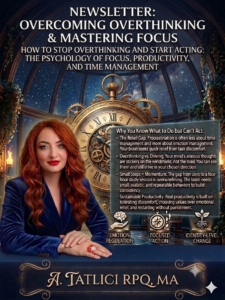
Sustainable productivity is built on three core processes:
When these three processes strengthen, productivity becomes a side effect—not a struggle.
These processes are consistent with modern process-based therapy models emphasizing cross-situational psychological processes rather than symptom-level change; Hayes, Hofmann, & Ciarrochi, 2021.
So let’s define your desired outcome in a very precise way now.
Not as a fantasy.
Not as a perfect version of you.
But as a realistic psychological shift.
Your desired outcome is not:
That is not humanly realistic.
Your desired outcome is this:
When your mind generates resistance…
You no longer automatically obey it.
When discomfort appears…
You no longer immediately escape it.
When you fall off track…
You do not collapse into self-judgment.
Instead:
You notice.
You return.
You continue.
This is what psychological flexibility looks like in lived behaviour (Hayes et al., 2016).
And now I want to make this even more human.
Because many of you listening right now are not struggling because you lack information.
You already know what you “should do.”
What you are missing is not knowledge.
It is tolerance for the internal experience that shows up when you try to do it.
That is the real barrier.
Not time.
Not planning.
Not intelligence.
But the moment-to-moment emotional resistance that appears when life requires effort.
This is trainable.
Not through force.
Not through pressure.
But through repeated small experiences of:
“I can feel this and still take one step.”
Research on exposure-based engagement shows that action in the presence of discomfort gradually reduces avoidance patterns and increases sustained engagement in meaningful tasks (Jacobson et al., 2001; Dimidjian et al., 2006).
You do not become a person who never struggles.
You become a person who does not get permanently stopped by struggle.
That is the shift.
And from that shift, something very different becomes possible:
Instead, you begin to trust something much more stable:
Your ability to take the next small step, even with a noisy mind.
That is the direction we are going:
Not control.
Not perfection.
Not discipline as punishment.
But a different relationship with action, attention, and internal experience.
A relationship where your life is no longer waiting for your mind to calm down before you live it.
And now, from this foundation, we move into something practical:
How exactly do we build focus when the mind keeps pulling us away?
How do we structure a day that does not collapse after motivation disappears?
And how do we design actions so small that your nervous system stops resisting them?
Let’s go there next.
Your mind will always produce thoughts.
Some helpful.
Some critical.
Some fearful.
But you are not required to follow all of them.
You are allowed to pause.
You are allowed to choose.
And you are allowed to take one small step forward even when your mind is uncertain.
Because change does not begin with confidence.
It begins with action.
And action builds confidence.
And confidence builds consistency.
And consistency changes everything.
If you are struggling with focus, procrastination, anxiety, or feeling stuck, you do not have to navigate this alone.
Support is not a weakness.
It is a structure that helps you return to yourself.
Aygul TATLICI RP-Q, FPSFP-L3
Dimidjian, S., Hollon, S. D., Dobson, K. S., Schmaling, K. B., Kohlenberg, R. J., Addis, M. E., Gallop, R., McGlinchey, J. B., Markley, D. K., Gollan, J. K., Atkins, D. C., Dunner, D. L., & Jacobson, N. S. (2006). Randomized trial of behavioral activation, cognitive therapy, and antidepressant medication in the acute treatment of adults with major depression. Journal of Consulting and Clinical Psychology, 74(4), 658–670. https://doi.org/10.1037/0022-006X.74.4.658
Hayes, S. C., Hofmann, S. G., & Ciarrochi, J. (2021). Process-based cognitive behavioral therapy: The science and core clinical competencies of cognitive behavioral therapy. New Harbinger Publications.
Hayes, S. C., Strosahl, K. D., & Wilson, K. G. (2016). Acceptance and commitment therapy: The process and practice of mindful change (2nd ed.). Guilford Press.
Hofmann, S. G., Sawyer, A. T., Witt, A. A., & Oh, D. (2010). The effect of mindfulness-based therapy on anxiety and depression: A meta-analytic review. Journal of Consulting and Clinical Psychology, 78(2), 169–183. https://doi.org/10.1037/a0018555
Jacobson, N. S., Martell, C. R., & Dimidjian, S. (2001). Behavioural activation treatment for depression: Returning to contextual roots. Clinical Psychology: Science and Practice, 8(3), 255–270. https://doi.org/10.1093/clipsy.8.3.255
Sirois, F. M., & Pychyl, T. A. (2013). Procrastination and the priority of short-term mood regulation: Consequences for future self. European Psychologist, 18(2), 115–127. https://doi.org/10.1027/1016-9040/a000138
Steel, P. (2007). The nature of procrastination: A meta-analytic and theoretical review of quintessential self-regulatory failure. Psychological Bulletin, 133(1), 65–94. https://doi.org/10.1037/0033-2909.133.1.65
Wood, W. (2019). Good habits, bad habits: The science of making positive changes that stick. Farrar, Straus and Giroux.
#Productivity #Focus #Procrastination #ExecutiveFunctioning #AttentionManagement #Motivation #TimeManagement #HowToFocus #FocusAndConcentration #StopProcrastinating #Overthinking #MentalHealth #EmotionalRegulation #PsychologicalFlexibility #BehaviorChange #SelfDiscipline #HabitFormation #GoalSetting #StressManagement #Burnout #Anxiety #PsychologyOfProductivity #ProductivityPsychology #HowToGetThingsDone #HowToFollowThrough #WhyCantIFocus #BehavioralActivation #Mindset #PersonalDevelopment #Psychotherapy #AygulTatlici #PsychotherapistAygulTatlici
Subscribe for monthly updates on mental health tips, therapy insights, and wellness strategies.
Stay connected with our community and receive valuable resources to support your mental health journey.
Fill out the form below and I'll get back to you within 24 hours.
Coaching is not psychotherapy; coaching does not diagnose or treat mental health conditions. Coaching focuses on personal development, goal achievement, and mindset shifts. It is not a substitute for a serious mental health treatment, diagnosis, or psychotherapy.