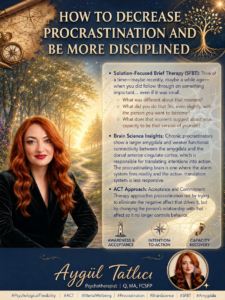
I want to start by saying something that you might not hear often enough:
You are not lazy.
You are not undisciplined.
And there is nothing wrong with you.
If you’ve been struggling to start, to follow through, or to stay consistent… it makes sense.
Because procrastination isn’t a time management problem.
It’s not about willpower.
It’s about emotion.
In those quiet moments right before you avoid something—there is usually something there.
A feeling. A weight. A hesitation.
Maybe it’s pressure.
Maybe it’s self-doubt.
Maybe it’s that sense of “this is too much, I don’t even know where to begin.”
Or maybe it’s just that the task feels heavy, boring, difficult.
And in that moment, your brain does something very human.
It tries to protect you.
It moves you away from discomfort—toward something easier, something lighter, something that gives you relief, even if only for a moment (Pychyl & Sirois, 2016; Steel, 2007).
So when you procrastinate, you’re not failing.
You’re responding.
The problem is… that response, while helpful in the short term, slowly pulls you away from something deeper.
From the version of you that you want to become.
If something shifted for you—not perfectly, just a little—
Who would you begin to see yourself as?
Maybe someone who starts a little sooner.
Maybe someone who follows through, even when it’s uncomfortable.
Maybe someone who doesn’t shut down when things feel uncertain.
Just notice what fits for you.
And now, imagine this—not as a big transformation, but something subtle:
If you were already becoming that version of you… even 10% more… what would be the first small signs?
What would you do differently today?
How would you respond when that urge to delay shows up?
What would others notice about you that tells them something is changing?
And maybe most importantly:
What would those small actions say about who you are?
You’re not starting from zero.
There have been moments—maybe small, maybe easy to overlook—where you did show up.
You started something, even when you didn’t feel ready.
You followed through, even with doubt.
You kept going, even when it was uncomfortable.
And those moments matter.
They tell you something about your capacity.
They tell you that the version of you you’re trying to become… is not separate from you.
It’s already there.
And when we look at procrastination more closely, it becomes clearer why this is so hard sometimes.
Sometimes you delay because you care so much that starting feels risky.
Because once you begin, you might not meet your own expectations (Frost et al., 1990).
Sometimes it’s because the task feels too big, too unclear—and your brain can’t find a starting point, so it pauses (Allen, 2001).
Sometimes it’s because it feels boring or unrewarding, and your mind naturally shifts toward something that feels better in the moment (Deci & Ryan, 2000).
None of this is weakness.
It’s human.
And what makes this even harder is something many people don’t realize:
Being hard on yourself doesn’t fix it.
In fact, it often makes it worse.
When you criticize yourself, your brain perceives it as a threat.
That increases anxiety.
And that makes avoidance more likely (Neff, 2011).
So if you’ve been telling yourself to “just be more disciplined”…
and it hasn’t worked…
It’s not because you’re not trying hard enough.
It’s because that’s not what you need.
What helps isn’t removing the discomfort.
It’s learning how to move with it.
To not let it decide for you.
And you don’t have to do that all at once.
You can start very simply.
The next time you notice yourself about to delay something, just pause for a moment.
Instead of saying, “I don’t feel like it,” try to gently name what’s actually there.
“This is anxiety.”
“This is overwhelm.”
“This is self-doubt.”
Even doing that begins to reduce the intensity of what you’re feeling (Lieberman et al., 2007).
Then, instead of getting caught in the thought—
“I can’t do this”
See if you can create just a little space:
“I’m having the thought that I can’t do this.”
It’s a small shift, but it changes your relationship with that thought.
You don’t have to fight it.
And you don’t have to obey it (Masuda et al., 2004).
And then, from that place—not from motivation, not from pressure—
Just take one small step.
Not the whole task.
Just something that moves you forward.
Open the document.
Write one sentence.
Spend five minutes.
That’s enough.
Because starting is not a small thing.
Starting is everything.
And as you move through your day, I want to leave you with this—not as pressure, but as a direction you can return to:
When that urge to delay shows up…
how do you want to respond, as the person you are becoming?
Change happens when you begin to notice what’s already working…
when you take small steps that align with who you want to be…
and when you allow yourself to feel discomfort without letting it stop you.
References (APA 7)
Allen, D. (2001). Getting things done: The art of stress-free productivity. Penguin.
Deci, E. L., & Ryan, R. M. (2000). The “what” and “why” of goal pursuits. Psychological Inquiry, 11(4), 227–268. https://doi.org/10.1207/S15327965PLI1104_01
Frost, R. O., Marten, P., Lahart, C., & Rosenblate, R. (1990). The dimensions of perfectionism. Cognitive Therapy and Research, 14, 449–468. https://doi.org/10.1007/BF01172967
Lieberman, M. D., Eisenberger, N. I., Crockett, M. J., Tom, S. M., Pfeifer, J. H., & Way, B. M. (2007). Putting feelings into words. Psychological Science, 18(5), 421–428. https://doi.org/10.1111/j.1467-9280.2007.01916.x
Masuda, A., Hayes, S. C., Sackett, C. F., & Twohig, M. P. (2004). Cognitive defusion and self-referential thoughts. Behaviour Research and Therapy, 42(4), 477–485. https://doi.org/10.1016/j.brat.2003.03.001
Neff, K. D. (2011). Self-compassion: The proven power of being kind to yourself. William Morrow.
Pychyl, T. A., & Sirois, F. M. (2016). Procrastination, emotion regulation, and well-being. In F. M. Sirois & T. A. Pychyl (Eds.), Procrastination, health, and well-being. Academic Press.
Steel, P. (2007). The nature of procrastination. Psychological Bulletin, 133(1), 65–94. https://doi.org/10.1037/0033-2909.133.1.65
Subscribe for monthly updates on mental health tips, therapy insights, and wellness strategies.
Stay connected with our community and receive valuable resources to support your mental health journey.
Fill out the form below and I'll get back to you within 24 hours.
Coaching is not psychotherapy; coaching does not diagnose or treat mental health conditions. Coaching focuses on personal development, goal achievement, and mindset shifts. It is not a substitute for a serious mental health treatment, diagnosis, or psychotherapy.