Your heart beats a little faster. Your breath becomes shallow. Your stomach tightens.
And in that sacred, terrifying moment, it is so easy to tell yourself: “Something is wrong with me.” It is easy to believe you must fix yourself, calm down, or become someone else entirely before you are allowed to be seen.
There is nothing wrong with you.
What you feel is not an enemy to be defeated. It is not a sign of weakness. It is, very often, a misguided protector. It is your body’s intense, overwhelming way of saying, “This matters deeply to me, and I am afraid of getting hurt.”
When we fight this feeling, we are fighting a part of ourselves that is just trying to care. Today, we are going to try a different approach. We are going to move from control to connection.
You are invited to heal exactly as you are, and to find your power not in perfection, but in presence.
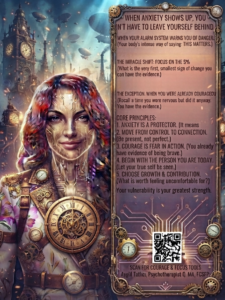
Let’s pause and try a little something together. You don’t have to “try hard” for this. Just allow your mind to drift into a possibility. Imagine tonight a positive shift occurs. The desire you have to perform, speak, or create is still there. You are still you. But the relationship between you and that internal alarm system has changed. It no longer has the final say over your actions. You don’t have to know how it happened. You just wake up, and the shift is real.
What would be the very first small sign tomorrow that this shift has begun? Would you wake up and feel a little more breath in your chest? Would you walk into the space where you will perform, and notice a part of you feels curious instead of just terrified? Would you allow yourself to begin not with a polished, rehearsed opening, but with a kind breath that connects you to the people in the room? Would you notice your hands shaking, and instead of thinking, “I’m failing,” think, “My body is just ready for this moment?” That first small sign? That is your new way of being already trying to create.
If you look closely at your own history, you don’t need us to invent a solution for you. You already have the evidence. We want you to recall a time—even if it was just for five seconds—when you were nervous, but you didn’t let the internal alarm system completely take over your behavior. Perhaps it was a time you spoke up in a meeting, your voice trembling, but you still said the words. Or a moment you hit ‘publish’ on a piece of art, your heart pounding, but you shared it anyway. Or a time you made a mistake during a performance, felt the flush of embarrassment, but didn’t stop. You kept going. What was happening then? What allowed you to act despite the fear? Perhaps you had a deep sense of why you were doing it—a love for the work, a desire to help someone, a commitment to growth. Perhaps you stopped focusing on what people were thinking of you, and started focusing on what you were sharing with them. In that exception, you weren’t fearless. You were courageous. And courage is not the absence of fear; it is love in action.
If anxiety is a protector, what is it protecting? Usually, it’s protecting a tender part of you—the part that cares about doing well, the part that longs to be respected, the part that fears rejection. We want you to connect with that tender part of yourself. Hold it with love. And then, we invite you to find a stronger emotion, a deeper need, that can stand beside that fear. Ask yourself: “What is important enough to me that I am willing to feel uncomfortable for it?” Is it growth? (Learning something new is always messy and uncomfortable). Is it contribution? Is it connection? Your vulnerability is your greatest strength. It is the gateway to connection and performance.
You do not need to perform perfectly. You do not need to eliminate anxiety. You do not need to wait: take one tiny, step this week toward presence. A step toward expressing 5% more of your true self. Instead of rehearsing your opening for the tenth time, spend that time connecting with someone you love. Record a one-minute video and send it to a trusted friend, not to get feedback, but just to practice being seen. Begin with the person you are today. Let them be seen, let them be heard, and let them be loved.
Subscribe for monthly updates on mental health tips, therapy insights, and wellness strategies.
Stay connected with our community and receive valuable resources to support your mental health journey.
Fill out the form below and I'll get back to you within 24 hours.
Coaching is not psychotherapy; coaching does not diagnose or treat mental health conditions. Coaching focuses on personal development, goal achievement, and mindset shifts. It is not a substitute for a serious mental health treatment, diagnosis, or psychotherapy.