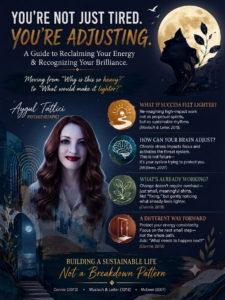
Some of the most driven, capable people in the world are feeling this.
People working in extraordinary environments—
well-paid, high-impact, surrounded by innovation—
and still… exhausted.
This isn’t a contradiction.
Research has shown that burnout happens when there’s a mismatch between you and the conditions you’re working in (Maslach & Leiter, 2016).
Not just workload.
But things like:
And when enough of these stack together, your system doesn’t say:
“This is success.”
It says:
“This is too much.”
Elliott Connie often reminds people:
“People are not broken—they are doing the best they can with what they have.” (Connie, 2013)
Your brain is not failing.
It is adjusting.
Under constant pressure:
So you might notice:
This is what chronic stress does to the brain over time (McEwen, 2007).
You’re not alone in this pattern.
Many high-performing people were taught something powerful—and risky:
That their value comes from what they produce.
So over time, work stops being something you do.
It becomes something you are.
And when that happens, rest feels uncomfortable.
Slowing down feels like failure.
And even success doesn’t feel like enough.
This pattern has been widely documented in modern work culture (Petersen & Warzel, 2021).
So when you feel exhausted, the thought becomes:
“I’m not doing enough.”
Instead of:
“This might not be sustainable.”
Here’s something Elliott Connie emphasizes in his work:
Change doesn’t start by fixing what’s wrong.
It starts by noticing what’s already working—even a little.
Even in the middle of all this pressure…
There are moments—small ones—where things feel slightly lighter.
Maybe:
Those moments matter more than they seem.
So instead of trying to solve everything, you might ask:
When do I feel even a little more like myself?
What’s different in those moments?
What am I doing—or allowing—that helps that happen?
You don’t need a complete life overhaul.
In fact, your brain doesn’t change that way.
It changes through repetition of small, meaningful experiences.
Each time you:
You are shaping your brain’s future responses (Siegel, 2012).
That’s how change happens.
Quietly. Gradually. Repeatedly.
Maybe you’ve noticed yourself doing less.
Not overextending.
Not going the extra mile.
Just doing what’s required.
And part of you might feel guilty about that.
But what if that’s not failure?
What if that’s your system trying to protect you?
Because research shows that a large portion of the workforce is experiencing disengagement right now (Gallup, 2023).
So what you’re doing might not be a flaw.
It might be an adjustment.
Elliott Connie often asks a simple but powerful question:
“What needs to happen next?”
Not everything.
Just next.
So instead of trying to fix your entire life, you might gently ask:
What helps me feel even slightly more like myself?
What am I already doing that protects my energy?
What would it look like to do just a little more of that?
There is nothing wrong with wanting to do meaningful work.
But you were never meant to disappear inside it.
And the fact that you’re noticing this—
questioning it—
feeling the weight of it—
That’s not weakness.
That’s awareness.
And as Elliott Connie often reminds us:
“Once you see something differently, new possibilities open.” (Connie & Froerer, 2019)
So maybe nothing is “wrong.”
Maybe something in you is ready
for a different way of doing this.
Connie, E. E. (2013). The solution focused marriage: 5 simple habits that will bring out the best in your relationship. Solution Tree Press.
Connie, E. E., & Froerer, A. S. (2019). The solution-focused brief therapy diamond: A new framework for solution-focused practice. Routledge.
Gallup. (2023). State of the global workplace 2023 report. Gallup Press.
Maslach, C., & Leiter, M. P. (2016). Understanding the burnout experience: Recent research and its implications for psychiatry. World Psychiatry, 15(2), 103–111. https://doi.org/10.1002/wps.20311
McEwen, B. S. (2007). Physiology and neurobiology of stress and adaptation: Central role of the brain. Physiological Reviews, 87(3), 873–904. https://doi.org/10.1152/physrev.00041.2006
Petersen, A. H., & Warzel, C. (2021). Out of office: The big problem and bigger promise of working from home. Knopf.
Siegel, D. J. (2012). The developing mind: How relationships and the brain interact to shape who we are (2nd ed.). Guilford Press.
Subscribe for monthly updates on mental health tips, therapy insights, and wellness strategies.
Stay connected with our community and receive valuable resources to support your mental health journey.
Fill out the form below and I'll get back to you within 24 hours.
Coaching is not psychotherapy; coaching does not diagnose or treat mental health conditions. Coaching focuses on personal development, goal achievement, and mindset shifts. It is not a substitute for a serious mental health treatment, diagnosis, or psychotherapy.