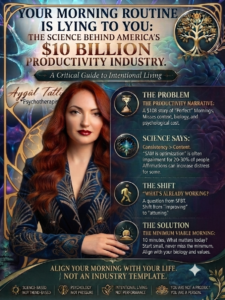
Let’s slow this down for a moment…
Because if you’ve been trying to “fix” your productivity—and maybe even your energy, your focus, your discipline, or even your sense of self—you may have been given a very convincing story:
That somewhere out there…
there is a perfect morning routine that will organize your mind, regulate your emotions, optimize your performance…
and quietly fix everything that feels off.
You’ve tried some of it.
Maybe even a lot of it.
And something didn’t fully translate.
Not because you failed.
But because the story you were given was incomplete.
The productivity industry—now valued at over $10 billion—has built a very specific narrative:
Successful people wake up early.
They follow structured routines.
They journal, visualize, plunge into cold water, and move through disciplined sequences.
And the implication is powerful:
“If you follow the same structure… you will access the same outcome.”
But what’s often missing is this:
So instead of asking:
“What is the best morning routine?”
We begin somewhere else:
“On a day that feels even slightly better… what is already working?”
That question alone shifts everything.
Let’s look carefully—because the science is not saying what the industry often claims.
There is real physiological evidence.
Kox et al. (2014) demonstrated activation of the sympathetic nervous system and immune modulation.
But:
So the question is not:
“Does this work?”
But:
“Does this work for you, in your current nervous system, in your actual life?”
Pennebaker’s research shows that expressive writing about emotional experiences reduces distress and improves wellbeing.
But most morning routines promote:
Which is not the same mechanism.
So again, we shift:
“What kind of writing actually changes your internal experience?”
The evidence is not universally positive.
Wood et al. (2009) found that for individuals with low self-esteem, affirmations can increase distress—because they highlight the gap between reality and statement.
So instead of repeating:
“I am confident”
We might ask:
“When have I already acted with even a small amount of confidence?”
That is where change becomes believable.
Process visualization works.
Outcome visualization often does not.
Pham & Taylor (1999) showed that imagining the steps of studying improved performance—while imagining success reduced effort.
So instead of imagining:
“The perfect future”
We ask:
“What does the first 2 minutes of that future actually look like?”
This is where the industry becomes actively misleading.
Research shows that 20–30% of people are biologically evening types (Roenneberg, 2012).
For them:
So if you’ve tried to force yourself into that structure and struggled…
That is not a discipline problem.
That is biological misalignment.
Consistency matters more than content (Lally et al., 2010)
Not what you do.
But that you do it… in the same context… repeatedly.
And what the industry accidentally discovered is something much simpler:
“When X happens, I do Y” (Gollwitzer & Sheeran, 2006)
This reduces:
So the power of a morning routine is not the routine itself.
It is:
The removal of the moment where you have to decide who you’re going to be.
And this is where I want to speak directly to you.
Because the difficulty is not usually the routine.
It’s what happens internally when the routine breaks.
You miss one day.
And suddenly the mind says:
“I failed.”
“I can’t even do this.”
“What’s wrong with me?”
This is not a productivity issue.
This is a cognitive pattern:
So one missed action becomes:
A statement about who you are
And that’s where people disengage.
We are looking for evidence.
Small, repeatable evidence that:
You already know how to start.
Instead of a 90-minute routine…
We design a 10-minute version.
Something that:
Never missing the minimum is more powerful than sometimes achieving the maximum.
Here is something the productivity industry almost never addresses:
Your morning is not just about output.
It is about nervous system regulation, connection, and relational presence.
So instead of building a routine that looks impressive…
You might begin with something quieter:
And then noticing:
What is already working… and doing a little more of that.
The productivity industry sells certainty.
But your life is not a template.
The most effective morning is not the most disciplined one.
It is the one that:
So tomorrow morning…
Don’t try to become someone else.
Just notice:
“What is the smallest sign that I’ve already begun?”
And let that be enough.
Gollwitzer, P. M., & Sheeran, P. (2006). Implementation intentions and goal achievement: A meta‐analysis of effects and processes. Advances in Experimental Social Psychology, 38, 69–119.
Kox, M., et al. (2014). Voluntary activation of the sympathetic nervous system and attenuation of the innate immune response in humans. Proceedings of the National Academy of Sciences, 111(20), 7379–7384.
Lally, P., van Jaarsveld, C. H., Potts, H. W., & Wardle, J. (2010). How are habits formed: Modelling habit formation in the real world. European Journal of Social Psychology, 40(6), 998–1009.
Pennebaker, J. W. (1997). Writing about emotional experiences as a therapeutic process. Psychological Science, 8(3), 162–166.
Pham, L. B., & Taylor, S. E. (1999). From thought to action: Effects of process versus outcome-based mental simulations on performance. Personality and Social Psychology Bulletin, 25(2), 250–260.
Roenneberg, T. (2012). Internal time: Chronotypes, social jet lag, and why you’re so tired. Harvard University Press.
Steele, C. M. (1988). The psychology of self-affirmation: Sustaining the integrity of the self. Advances in Experimental Social Psychology, 21, 261–302.
Wood, J. V., Perunovic, W. Q. E., & Lee, J. W. (2009). Positive self-statements: Power for some, peril for others. Psychological Science, 20(7), 860–866.
Subscribe for monthly updates on mental health tips, therapy insights, and wellness strategies.
Stay connected with our community and receive valuable resources to support your mental health journey.
Fill out the form below and I'll get back to you within 24 hours.
Coaching is not psychotherapy; coaching does not diagnose or treat mental health conditions. Coaching focuses on personal development, goal achievement, and mindset shifts. It is not a substitute for a serious mental health treatment, diagnosis, or psychotherapy.