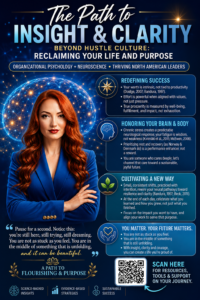
Organizational Psychology + Neuroscience · North American High Achievers
Take a breath with me.
Not the kind of breath you take between emails. Not the kind you rush through while thinking about your next task. A real one.
Maybe you’ve been feeling exhausted, overwhelmed, or quietly disconnected from your own life…
Seventy-seven percent of workers in American culture report significant physical symptoms caused by workplace stress—fatigue, headaches, muscle tension, digestive issues (American Psychological Association, 2023).
And yet, despite how real your exhaustion feels, there is likely a part of you that still says:
“I should be able to handle this.”
“I just need to be more disciplined.”
“Everyone else is doing it.”
But let’s gently question that together.
Because the culture you are living in has taught you something very powerful—and very costly:
That your worth is tied to how much you produce.
That rest must be justified.
That being constantly busy means you matter.
This belief system didn’t come from nowhere. It has deep roots in what Max Weber described as the Protestant work ethic, where effort became linked to moral value (Weber, 1905/1930). Over time, that idea evolved into something even more intense—what you now see in hustle culture.
You’ve seen it.
The 70-hour workweeks.
The pride in sleeping less.
The subtle pressure to always be “on.”
Because when researchers studied productivity—not opinions, not motivation, but actual output—they found something that challenges everything hustle culture promises:
After about 49 hours per week, productivity begins to decline. After 55 hours, working more does not produce more (Pencavel, 2015).
So if you’ve been working beyond that, trying to prove your dedication or secure your future…
It makes sense that you feel tired.
And your body has been trying to tell you.
Working 55+ hours per week is associated with a 33% increased risk of stroke and 13% increased risk of heart disease (Kivimäki et al., 2015). Chronic stress changes the brain—reducing memory, clarity, and decision-making while increasing emotional reactivity (McEwen, 2008).
So if you’ve been feeling more anxious, more irritable, less focused…
That is not weakness.
That is your nervous system asking for something different.
And yet, even with all of this, you have kept going.
Which tells me something important about you:
You are not lazy.
You are not unmotivated.
You are someone who has been trying—very hard—to build a meaningful life.
And maybe, just maybe, the next step is not to try harder… but to try differently.
Let’s slow this down together.
Think about your last week—not the whole thing, just small moments.
When did you feel even slightly more focused, more present, or more effective?
Maybe it was when you worked without interruption.
Maybe it was when you allowed yourself to pause.
Those moments matter.
Because they are already showing you what works.
And instead of asking yourself, “How do I survive this?”—you might begin asking:
How can I create just a little more of what is already working?
Across countries like Norway and Denmark, people work fewer hours yet produce more per hour and report higher wellbeing. They protect recovery time. They separate work from life. They measure success by output—not exhaustion.
And this is important:
They are not less ambitious than you.
They are simply working in a way that supports their brain, their body, and their long-term performance.
Which means another way is possible.
And you don’t have to change everything at once to begin.
Start noticing the beliefs you’ve been carrying:
“I have to respond immediately.”
“If I rest, I fall behind.”
Pause with each one and ask:
Is this always true? Or is this something I’ve learned to believe?
Because many of these beliefs are not requirements—they are inherited assumptions.
Then begin observing your work differently.
At the end of each day, ask yourself:
What actually mattered today?
What did I do that had real impact?
You may start to notice something surprising:
Your best work does not come from your longest hours.
It comes from your most focused ones.
And then, something that may feel uncomfortable—but powerful:
Allow yourself recovery.
Not as a reward. Not as something you earn.
But as something that supports your performance.
Even a few hours where you are not checking, not thinking, not preparing.
Research shows that stepping away from work improves the quality of the work that follows—not the opposite.
So instead of asking, “Can I afford to rest?”—
Try asking:
What might become possible if I did?
And underneath all of this, there is a quieter question waiting for you:
What do I want my work to stand for?
Not what you were told to want.
Not what others expect.
But what genuinely matters to you.
Contribution?
Creativity?
Stability?
Impact?
Because when your work aligns with your values—not just your pressure—you begin to feel something different.
Not just productive.
But fulfilled.
There are moments when everything inside you feels tangled—like your thoughts won’t slow down, your emotions come in waves, and even the smallest things feel exhausting. If that’s where you are right now, pause for a second and notice this: you’re still here, still trying, still searching for something that helps. That matters more than you think.
You might have been carrying patterns that feel stuck—overthinking, self-doubt, emotional overwhelm, maybe even that quiet voice that tells you things won’t change. And yet, there have been moments—however small—when things were just a little lighter. Maybe you handled something better than expected, or you got through a hard day, or you felt even a brief sense of calm. Those moments are not accidents. They are evidence.
Research shows that even subtle shifts in attention and behavior can begin to rewire emotional patterns over time (Doidge, 2007). The brain is not fixed—it adapts based on what we repeatedly focus on and practice. That means change doesn’t come from one big breakthrough; it builds through small, consistent shifts.
So let’s stay with that for a moment. Think about a recent time—even a tiny one—when things felt slightly more manageable. What was different about that moment? What were you doing, thinking, or not doing? These details matter because they point toward what is already working within you.
You don’t need to fix everything at once. In fact, trying to do that often keeps you stuck. Instead, consider what “just a little better” would look like today. Not perfect. Not completely healed. Just a small step forward. Maybe it’s getting out of bed with a bit more intention. Maybe it’s interrupting one negative thought. Maybe it’s choosing one action that supports you instead of drains you.
Studies suggest that focusing on small, achievable goals increases motivation and builds momentum, especially when people recognize their own role in progress (Bandura, 1997). This sense of agency—knowing you can influence your experience—is one of the strongest predictors of emotional resilience.
And even if it doesn’t feel like it, you have already been using strengths to get this far. The way you cope, the way you endure, the way you keep searching—these are not weaknesses. They are signs of persistence. Sometimes they just need to be redirected, refined, or supported.
There’s also something important about noticing what hasn’t been as overwhelming as expected. Maybe there were situations that could have gone worse but didn’t. Maybe you handled something differently than you used to. These exceptions are powerful—they show that the problem is not constant, not permanent, and not defining you.
As you move forward, try this gently: when a difficult thought shows up, don’t fight it aggressively. Instead, notice it, name it, and ask yourself, “Is there another way to look at this?” Even creating a small gap between you and the thought can reduce its intensity (Beck, 2011).
And when emotions feel overwhelming, grounding yourself in the present moment—through your breath, your surroundings, or simple physical sensations—can help regulate your nervous system. Research in emotional regulation shows that these small grounding practices can significantly reduce distress over time (Gross, 2015).
You don’t need to have all the answers today. You don’t need to feel completely okay. What matters is that you are willing to stay engaged with yourself, even when it’s hard.
So here’s something to hold onto:
If even 5% of your day felt lighter, what would be happening in that 5%?
And what would it take to gently expand it to 6% tomorrow?
Change often begins there—not in dramatic transformation, but in quiet shifts that grow over time.
You are not as stuck as you feel. You are in the middle of something that is still unfolding.
Bandura, A. (1997). Self-efficacy: The exercise of control. W.H. Freeman.
Beck, J. S. (2011). Cognitive behavior therapy: Basics and beyond (2nd ed.). Guilford Press.
de Shazer, S., Dolan, Y., Korman, H., Trepper, T., McCollum, E., & Berg, I. K. (2007). More than miracles: The state of the art of solution-focused brief therapy. Routledge.
Doidge, N. (2007). The brain that changes itself: Stories of personal triumph from the frontiers of brain science. Viking.
Gross, J. J. (2015). Emotion regulation: Current status and future prospects. Psychological Inquiry, 26(1), 1–26.
American Psychological Association. (2023). Work and well-being survey.
Hemp, P. (2004). Presenteeism: At work—but out of it. Harvard Business Review.
International Labour Organization. (n.d.). Working time and productivity.
Kivimäki, M., Jokela, M., Nyberg, S. T., Singh-Manoux, A., Fransson, E. I., Alfredsson, L., et al. (2015). Long working hours and risk of coronary heart disease and stroke: A systematic review and meta-analysis of 603,838 individuals. The Lancet, 386(10005), 1739–1746.
McEwen, B. S. (2008). Central effects of stress hormones in health and disease. European Journal of Pharmacology, 583(2–3), 174–185.
Pencavel, J. (2015). The productivity of working hours. The Economic Journal, 125(589), 2052–2076.
RAND Corporation. (2016). Why sleep matters: The economic costs of insufficient sleep.
Robinson, B. E. (2014). Chained to the desk (3rd ed.). New York University Press.
Weber, M. (1930). The Protestant ethic and the spirit of capitalism (Original work published 1905). Scribner.
Subscribe for monthly updates on mental health tips, therapy insights, and wellness strategies.
Stay connected with our community and receive valuable resources to support your mental health journey.
Fill out the form below and I'll get back to you within 24 hours.
Coaching is not psychotherapy; coaching does not diagnose or treat mental health conditions. Coaching focuses on personal development, goal achievement, and mindset shifts. It is not a substitute for a serious mental health treatment, diagnosis, or psychotherapy.