Career Resilience ACT | Workplace Resilience Psychology | Professional Setback Recovery | SFBT Career |
Psychotherapist Aygul Tatlici
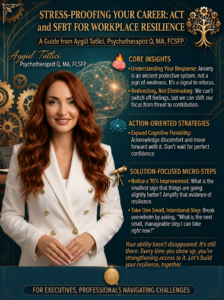
Let’s slow this down for a moment.
Not the situation. Not the pressure. Just this moment.
Because if you’re here, reading this, chances are you’ve been carrying something heavy—something that doesn’t always show on the outside but quietly shapes how you think, how you feel, and how you move through your day. You might even be wondering, “Am I still capable of handling this?” And that question can feel overwhelming. But it’s also incomplete—because it leaves out something important: you are still here. Still showing up. Still searching. Still trying, even in ways that may feel invisible. And that matters more than your mind is currently allowing you to see.
In solution-focused work, we gently shift attention from what is broken to what is already working—even if only slightly (de Shazer et al., 2007). So let me ask you something different: What has helped you get through even this much? Not perfectly. Not consistently. Just enough to still be here today. Because something—some strength, some value, some part of you—has been carrying you forward. That is not an accident. That is evidence.
When Satya Nadella stepped into leadership at Microsoft, the company was under enormous pressure. Critics questioned its future, innovation had slowed, and expectations were high. He could have focused on everything that was going wrong. Instead, he shifted the question: “What can we build next?” That small shift—from problem to possibility—is at the heart of resilience. Research shows that future-focused thinking and goal orientation can significantly improve motivation and emotional recovery (Snyder, 2002).
And here’s where your mind might need a gentle update.
Under stress, our thoughts tend to become more rigid, more negative, and more convincing (Beck, 2011). You might notice thoughts like “This is too much,” “I can’t do this,” or “Nothing will change.” These thoughts feel real—but they are not facts. In cognitive behavioral therapy (CBT), we don’t fight thoughts—we examine them. We ask: Is this the only way to see this situation? Is this thought helping me move forward?
Because even a small shift in thinking can create a meaningful shift in how you feel.
Take Sara Blakely, for example. Before building her billion-dollar company, she faced repeated failures—including not passing the LSAT. That moment could have easily turned into a fixed belief: “I’m not capable.” But it didn’t. Instead, she reframed failure as feedback—something to learn from rather than something that defines her. This aligns with research on growth mindset, which shows that how we interpret setbacks directly influences resilience and future success (Dweck, 2006).
Now pause for a moment.
Imagine—not perfection—but a version of your life that feels just a little lighter. You’re coping slightly better. There’s a bit more clarity, a bit more steadiness. In solution-focused therapy, we call this the preferred future—and even imagining it begins to activate change (de Shazer et al., 2007).
So ask yourself:
What would be the first small sign that things are getting better?
Maybe it’s getting out of bed with a little less resistance.
Maybe it’s replying to a message.
Maybe it’s allowing yourself a moment of rest without guilt.
These are not small things.
They are indicators of movement.
And movement matters.
Even Elon Musk faced repeated, very public failures with SpaceX. Early rocket launches failed. Financial pressure mounted. At multiple points, success seemed unlikely. But resilience is not about avoiding difficulty—it’s about continuing despite it. Studies show that persistence, especially when paired with adaptive thinking, is one of the strongest predictors of long-term success (Duckworth et al., 2007).
Now let’s bring this back to you.
Because right now, your situation may include stress, exhaustion, or even physical limitations. And that matters. Especially when your body is under strain, your emotional capacity naturally narrows. That’s not weakness—that’s human physiology. Pain and fatigue directly impact mood, motivation, and thinking patterns (Eccleston & Crombez, 1999).
So instead of asking yourself to do more, try asking:
What is manageable right now?
Maybe it’s not physical activity—but connection is still possible. A message. A short conversation. Even being present with someone for a few minutes. Research consistently shows that connection and communication play a critical role in emotional resilience and recovery (Holt-Lunstad et al., 2010).
You don’t have to do everything.
You just have to do something that moves you slightly forward.
And sometimes, that “something” is internal.
A breath.
A pause.
A moment of grounding.
Even brief breathing and grounding exercises have been shown to reduce stress and improve emotional regulation (Kabat-Zinn, 1990). Not because they solve everything—but because they create space. And in that space, you regain just enough control to take the next step.
So here’s where we gently land:
You are not stuck.
You are in a moment.
And moments change.
Not all at once.
But gradually—through small shifts, small steps, and small acts of persistence.
So instead of asking,
“Is this too much?”
Try asking,
“What is one thing I can do from here?”
Because you are not starting from zero.
You are starting from experience.
From strength.
From everything that has already helped you survive this far.
And that version of you?
It’s still here.
#Resilience #MentalHealth #CBT #SolutionFocusedTherapy #StressManagement #EmotionalWellbeing #GrowthMindset #Healing #Motivation #Psychology #ChronicIllnessSupport #MindsetShift #SelfCompassion
Beck, J. S. (2011). Cognitive behavior therapy: Basics and beyond (2nd ed.). Guilford Press.
de Shazer, S., Dolan, Y., Korman, H., Trepper, T., McCollum, E., & Berg, I. K. (2007). More than miracles: The state of the art of solution-focused brief therapy. Routledge.
Duckworth, A. L., Peterson, C., Matthews, M. D., & Kelly, D. R. (2007). Grit: Perseverance and passion for long-term goals. Journal of Personality and Social Psychology, 92(6), 1087–1101.
Dweck, C. S. (2006). Mindset: The new psychology of success. Random House.
Eccleston, C., & Crombez, G. (1999). Pain demands attention: A cognitive–affective model of pain. Psychological Bulletin, 125(3), 356–366.
Holt-Lunstad, J., Smith, T. B., & Layton, J. B. (2010). Social relationships and mortality risk. PLoS Medicine, 7(7), e1000316.
Kabat-Zinn, J. (1990). Full catastrophe living. Delacorte.
Snyder, C. R. (2002). Hope theory: Rainbows in the mind. Psychological Inquiry, 13(4), 249–275.
Subscribe for monthly updates on mental health tips, therapy insights, and wellness strategies.
Stay connected with our community and receive valuable resources to support your mental health journey.
Fill out the form below and I'll get back to you within 24 hours.
Coaching is not psychotherapy; coaching does not diagnose or treat mental health conditions. Coaching focuses on personal development, goal achievement, and mindset shifts. It is not a substitute for a serious mental health treatment, diagnosis, or psychotherapy.