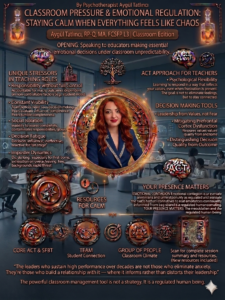
There is something I want you to know before we talk about strategies, research, or emotional regulation.
I want you to know that I see you.
Not just the teacher standing in front of the classroom.
Not just the professional managing lessons, deadlines, behavior plans, meetings, assessments, and expectations.
I feel you.
The person who cares deeply.
The person who worries about students long after the school day ends.
The person who wonders if they did enough.
The person who drives home replaying difficult moments and wishing they had handled them differently.
The person who is carrying far more than most people realize.
You are doing one of the most emotionally demanding jobs in the world.
Every day you walk into a room full of human beings with different needs, stories, struggles, and hopes.
And somehow, while helping them navigate their emotions, you are expected to manage your own.
The fact that teaching feels hard sometimes does not mean you are doing it wrong.
It means you are human.
Most teachers don’t struggle because they don’t know enough.
Most teachers don’t struggle because they don’t care enough.
Often, they struggle because there are moments when the pressure becomes overwhelming.
You know those moments.
The lesson isn’t working.
The class is louder than usual.
A student challenges you.
Someone refuses to participate.
Another student is upset.
The technology fails.
And suddenly, something begins happening inside.
Your chest tightens.
Your thoughts speed up.
You feel frustration rising.
Maybe anxiety.
Maybe self-doubt.
Maybe exhaustion.
And then another voice appears.
“You should be handling this better.”
“Why can’t you get control of this class?”
“Other teachers probably don’t struggle like this.”
Can I gently challenge that voice for a moment?
Because that voice often tells a very incomplete story.
What it doesn’t tell you is that every teacher has difficult moments.
Every teacher gets overwhelmed.
Every teacher experiences frustration.
Every teacher has days that don’t go according to plan.
The difference is not whether difficult emotions show up.
The difference is what happens next.
Imagine you’re teaching and frustration shows up.
Instead of immediately fighting it, judging it, or trying to push it away, you simply notice:
“Frustration is here.”
Not:
“I am failing.”
Not:
“I shouldn’t feel this.”
Just:
“Frustration is here.”
That small shift creates space.
And inside that space lives something incredibly important.
Choice.
Because when we stop fighting our emotions, we often discover that we have more energy available to respond wisely.
Not perfectly.
Wisely.
When teachers come to me feeling discouraged, I rarely start by asking what’s wrong.
Instead, I ask something different.
When have you handled a difficult classroom situation well?
Not perfectly.
Just well enough.
Take a moment and think about that.
There was probably a day when things could have gone badly but didn’t.
A moment when you stayed calmer than expected.
A time when you connected with a struggling student.
A moment when you chose understanding instead of conflict.
What helped?
What were you doing?
What did you notice?
What strengths were present?
I ask these questions because solutions often leave clues.
The abilities you need are usually not missing.
They’re already there.
Sometimes they get hidden beneath stress.
I wonder if you’ve ever noticed that your most meaningful teaching moments probably didn’t happen because you had the perfect lesson plan.
They happened because of who you were.
Your patience.
Your kindness.
Your consistency.
Your willingness to listen.
Your ability to stay present.
Your belief in students.
Those qualities matter more than you realize.
And they don’t disappear when stress arrives.
They may become harder to access.
But they are still there.
Waiting.
Research tells us that emotions are contagious.
Students constantly respond to the emotional signals around them.
Your tone.
Your facial expression.
Your pace.
Your presence.
A grounded teacher helps create a grounded classroom.
A regulated teacher helps students feel safe.
And here’s something important:
Students do not need you to be perfectly calm.
They need you to be genuinely present.
There is a difference.
Many teachers spend their days performing calm while feeling overwhelmed inside.
That is exhausting.
Eventually, it drains the very energy needed for teaching.
What students respond to most is authenticity combined with regulation.
A teacher who notices stress, responds thoughtfully, and remains connected to their values.
That kind of presence creates trust.
If teaching feels especially hard at the moment, I want you to consider one final question.
Not:
“How do I become a better teacher?”
But:
“What is one small thing I am already doing that is helping?”
Maybe it’s greeting students warmly.
Maybe it’s pausing before responding.
Maybe it’s showing up despite exhaustion.
Maybe it’s offering kindness to a struggling child.
Maybe it’s simply continuing to care.
Don’t overlook small successes.
Small successes become larger successes.
Small moments of regulation become larger moments of regulation.
Small acts of compassion create lasting impact.
You were never meant to carry the entire weight of every student’s success.
You were never meant to be perfect.
You were never meant to have unlimited patience, unlimited energy, or unlimited answers.
You are a human being doing meaningful work.
And meaningful work is often messy.
So the next time the lesson falls apart…
The next time a student challenges you…
The next time you feel frustration, anxiety, or self-doubt rising…
See if you can pause for just a moment.
Take one breath.
Place your feet on the floor.
Notice what is happening.
And ask yourself:
“What would the teacher I most want to be do next?”
Not tomorrow.
Not next year.
Just next.
Because healing, growth, and effective teaching rarely happen all at once.
They happen one moment, one choice, and one breath at a time.
And if nobody has reminded you recently:
You matter.
Your presence matters.
The care you bring into your classroom matters.
And even on the days when it doesn’t feel like enough, you are making a difference in ways you may never fully see.
A.TATLICI RP-Q, MA, FCSFP L3
Subscribe for monthly updates on mental health tips, therapy insights, and wellness strategies.
Stay connected with our community and receive valuable resources to support your mental health journey.
Fill out the form below and I'll get back to you within 24 hours.
Coaching is not psychotherapy; coaching does not diagnose or treat mental health conditions. Coaching focuses on personal development, goal achievement, and mindset shifts. It is not a substitute for a serious mental health treatment, diagnosis, or psychotherapy.