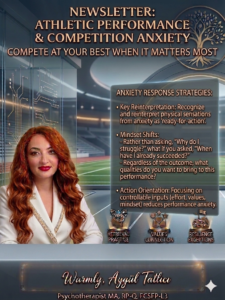
The training is done.
The preparation is complete.
And then competition arrives.
Have you ever noticed how different things can feel once the event becomes real?
Have you ever felt confident during practice and found yourself questioning everything just before competition?
Have you ever wondered why your heart races, or your mind suddenly starts imagining everything that could go wrong?
If so, you are not alone.
Research tells us that anxiety is common among athletes, including elite athletes. In fact, many athletes experience significant levels of anxiety before competition. The experience is so common that perhaps a more useful question is not, “How do I stop feeling anxious?” but rather, “How do I want to respond when anxiety shows up?”
What if anxiety is not a sign that something is wrong?
What if it is a sign that something matters?
When athletes talk about competition anxiety, they often describe two experiences.
Sometimes it shows up in the mind.
“What if I fail?”
“What if I disappoint people?”
“What if I make a mistake?”
“What if I choke?”
Other times it shows up in the body.
A racing heart.
Muscle tension.
Restlessness.
A surge of energy.
Have you noticed which type tends to show up for you?
Or do you experience both?
Many athletes assume that the goal is to get rid of these experiences. Yet research suggests that what may matter most is not how much anxiety you feel, but how you interpret it.
What meaning do you give anxiety?
When your heart is beating faster before competition, do you tell yourself, “This is bad”?
Or could it also mean, “My body is preparing me”?
When you feel nervous before an important event, do you see it as evidence that you are incapable, or evidence that you care deeply about what you are about to do?
The same physical sensations can be interpreted in very different ways.
One athlete might think, “This anxiety will hurt my performance.”
Another might think, “This energy can help me perform.”
What if the most important difference is not the anxiety itself, but the story attached to it?
Acceptance and Commitment Therapy offers an alternative perspective.
Instead of fighting anxiety, what would happen if you made room for it?
Instead of treating anxiety as an enemy, what if you viewed it as evidence that you are stepping toward something meaningful?
After all, would you feel nervous if the competition meant nothing to you?
Would you invest so much effort into preparation if you did not care about the outcome?
Perhaps anxiety is not proof that you are unprepared.
Perhaps it is proof that you are invested.
Athletes often become trapped by their thoughts.
Have you ever noticed your mind making predictions before a competition?
“I’m going to choke.”
“I’m not ready.”
“I can’t handle this.”
But what if thoughts are not predictions?
What if they are simply thoughts?
One small but powerful shift is to notice the difference between saying:
“I’m going to choke.”
and
“My mind is having the thought that I might choke.”
What changes when you add those few words?
Does the thought feel slightly less powerful?
Does it become easier to see it as a mental event rather than a certainty?
The goal is not to convince yourself that the thought is false.
The goal is to recognize that a thought is not the same thing as reality.
What if you could carry anxious thoughts with you without allowing them to determine your behavior?
What if confidence was not required before taking action?
What if your values could guide you instead?
When competition begins, what kind of athlete do you want to be?
Do you want to compete with courage?
Discipline?
Commitment?
Respect?
Resilience?
If anxiety is present, can you still bring those qualities?
If confidence is low, can you still compete according to your values?
Many athletes spend enormous energy trying to control how they feel.
What happens if you shift your attention toward how you want to act instead?
You are not your anxiety.
You are the person noticing anxiety.
You are not your self-doubt.
You are the person observing self-doubt.
Imagine anxiety as weather.
Some days the weather is calm.
Some days it is stormy.
The weather changes.
The sky remains.
Could it be that anxiety is simply weather passing through your experience rather than a definition of who you are?
Solution-Focused Brief Therapy invites another important set of questions.
Rather than asking, “Why do I struggle?” what if you asked, “When have I already succeeded?”
Can you think of a time when you competed brilliantly despite feeling nervous?
What was different about that day?
What were you focusing on?
How were you preparing?
What did you tell yourself?
Who noticed you performing at your best?
What would they say you were doing well?
If you watched a video of that performance, what strengths would stand out?
What helped you stay focused?
What allowed you to keep going?
What if the answers to your future success already exist within your past successes?
What if your best performances contain clues about what works for you?
Many athletes already possess effective strategies. They have not stopped long enough to identify them.
Pressure can sometimes lead athletes to overthink.
Have you ever caught yourself trying to consciously control movements that normally happen automatically?
Have you ever performed better when you stopped analyzing every detail?
Research on choking under pressure suggests that performance often suffers when athletes direct too much conscious attention toward skills that are normally automatic.
What happens when you shift your focus away from outcomes and toward simple process cues?
Instead of thinking, “I have to win,” what happens if your focus becomes:
“Quick first step.”
“Strong follow-through.”
What process cues help you perform at your best?
Which cues keep your attention on execution rather than evaluation?
Many athletes also benefit from a consistent pre-performance routine.
What do you naturally do before your best performances?
Do you review notes?
Listen to music?
Take a walk?
Visualize success?
Use specific self-talk?
Spend time with teammates?
Take a few quiet moments alone?
What helps you feel focused, prepared, and ready?
Rather than creating a routine from scratch, what if you simply identified what already works and repeated it intentionally?
A pre-performance routine does not guarantee perfection.
Its purpose is to create familiarity.
Its purpose is to help you access strengths and resources that are already available to you.
Before your next competition, you might ask yourself:
“What else could these nerves mean?”
Could they mean that this matters?
Could they mean that you are ready to engage?
Could they mean that your body is mobilizing energy for performance?
You might also ask:
“When have I handled pressure successfully before?”
“What strengths did I demonstrate then?”
“How can I bring those strengths with me today?”
You might identify two or three process cues that help you stay focused.
And before competition begins, you might complete this sentence:
“Today I compete in service of __________.”
Then ask yourself:
“Regardless of the outcome, what qualities do I want to bring to this performance?”
Perhaps courage.
Perhaps determination.
Perhaps discipline.
Perhaps effort.
The best athletes are not necessarily the athletes who never feel anxious.
The best athletes are often the ones who have learned how to move forward while anxiety is present.
What if your goal is not to eliminate anxiety?
What if your goal is to compete fully, courageously, and effectively with anxiety along for the ride?
And what if, before your next competition, you reminded yourself of one simple truth:
You do not have to compete without anxiety.
You simply have to learn how to compete with it.
Subscribe for monthly updates on mental health tips, therapy insights, and wellness strategies.
Stay connected with our community and receive valuable resources to support your mental health journey.
Fill out the form below and I'll get back to you within 24 hours.
Coaching is not psychotherapy; coaching does not diagnose or treat mental health conditions. Coaching focuses on personal development, goal achievement, and mindset shifts. It is not a substitute for a serious mental health treatment, diagnosis, or psychotherapy.