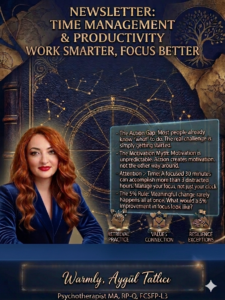
One of the most common things I hear people say is:
“I just need better time management.”
And maybe you’ve said that too.
Maybe you’ve bought a planner.
Downloaded an app.
Created a schedule.
Made a to-do list.
And perhaps it worked for a few days.
Maybe even a few weeks.
But eventually you found yourself right back where you started.
If that’s happened, I’d like to suggest something.
Perhaps the problem isn’t that you don’t know how to organize your time.
Perhaps the problem is something else.
Let me explain.
When people struggle with time management, they often assume they have a planning problem.
But when I talk with people, I usually discover something interesting.
Most already know what they need to do.
They know the assignment needs to be started.
They know the report needs to be written.
They know the phone call needs to be made.
The challenge is rarely a lack of information.
The challenge is getting started.
And that’s very different.
So let me ask you something.
Think about the task you’ve been putting off recently.
Now imagine that tonight, suddenly the struggle around that task is noticeably smaller.
Not gone.
Just better.
What would be the first sign?
Would you start sooner?
Would you stop checking your phone?
Would you spend less time thinking about doing it and more time actually doing it?
I’m asking because your answer begins to describe a solution.
Not my solution.
Yours.
And once we can describe what better looks like, we can start moving toward it.
Here’s something else I’ve noticed.
People often wait for motivation.
They tell themselves:
“When I feel motivated, I’ll start.”
The problem is that motivation is unpredictable.
Some days it’s there.
Some days it isn’t.
So let me ask another question.
Can you think of a time when you completed something important without feeling motivated?
Most people can.
Maybe you went to work when you didn’t feel like it.
Maybe you studied when you were tired.
Maybe you exercised when you would rather have stayed on the couch.
What helped you do it?
The reason that question matters is because your answer often reveals a strategy you already possess.
Perhaps you started small.
Perhaps someone was counting on you.
Perhaps you reminded yourself why it mattered.
Whatever the answer is, that’s valuable information.
Because it tells us something about how you succeed when motivation is absent.
And that’s a skill worth paying attention to.
And some people think that they need more time
And sometimes that’s true.
But often when we look more closely, we discover they don’t actually need more time.
They need more focused attention.
Think about the last hour you spent working.
How much of that hour was actually spent working?
How much was spent checking messages?
Switching tabs?
Thinking about other things?
Worrying?
Planning?
The reason I ask is because attention is often more important than time.
According to recent research a focused thirty minutes can accomplish more than three distracted hours.
So if your productivity improved this week, what would you be doing differently with your attention?
What would you spend less time on?
What would you spend more time on?
Again, those answers matter.
Because they point toward actions that are already within your control.
Rather than asking:
“What’s wrong with me?”
You might ask:
“When am I already doing this better?”
Rather than asking:
“How do I become a completely different person?”
You might ask:
“What would a 5% improvement look like?”
Because meaningful change rarely happens all at once.
It happens one small action at a time.
One decision.
One adjustment.
One moment of choosing what matters.
So as you finish reading this, I’d like to leave you with one final question.
If your relationship with time improved by just 5% this week, what would you notice yourself doing differently?
And what is one small step you could take today that would move you in that direction?
That might be a very good place to begin.
Warmly,
Aygül Tatlıcı
Psychotherapist MA, RP-Q, FCSFP-L3
Subscribe for monthly updates on mental health tips, therapy insights, and wellness strategies.
Stay connected with our community and receive valuable resources to support your mental health journey.
Fill out the form below and I'll get back to you within 24 hours.
Coaching is not psychotherapy; coaching does not diagnose or treat mental health conditions. Coaching focuses on personal development, goal achievement, and mindset shifts. It is not a substitute for a serious mental health treatment, diagnosis, or psychotherapy.