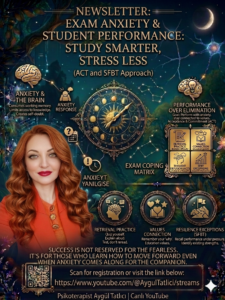
You sit down at your desk.
The exam paper is in front of you.
You know you’ve studied. You’ve spent hours reading, reviewing, highlighting, making notes, watching videos, and trying your best to prepare.
Yet within seconds, something shifts.
Your heart starts racing.
Your stomach tightens.
Your mind begins firing questions at you faster than you can answer them.
“What if I fail?”
“What if I’ve forgotten everything?”
“What if everyone else is more prepared than I am?”
And suddenly, the exam feels less like a test of what you know and more like a battle with your own mind.
If this sounds familiar, you’re far from alone.
In fact, one of the most common things I hear from students is not, “I don’t know the material.”
It’s:
“I know it when I’m studying. I just can’t seem to access it when it matters.”
Many students assume this means they are not smart enough, not disciplined enough, or not prepared enough.
But what if that isn’t the real problem?
What if the issue isn’t a lack of ability at all?
What if anxiety is simply getting in the way of abilities you already possess?
Research on exam anxiety suggests exactly that.
When we’re anxious, our minds become busy trying to protect us. Unfortunately, they often do this by generating an endless stream of warnings.
“Don’t mess this up.”
“You’re running out of time.”
“You should know this.”
“This is important.”
The mind believes it’s helping.
But the same mental resources needed for problem-solving, reasoning, and memory retrieval become occupied by worry.
Imagine trying to solve a difficult problem while someone is standing beside you constantly talking.
Your intelligence hasn’t disappeared.
Your knowledge hasn’t vanished.
There’s too much noise.
For many students, exam anxiety works in the same way.
Perhaps you’ve experienced this yourself.
You leave the exam room disappointed.
An hour later, while walking home, the answer suddenly appears in your mind.
Or perhaps you’ve explained a concept perfectly to a friend the night before, only to struggle with the same concept during the test.
If that has happened, what does it tell you?
It suggests something important.
The knowledge may have been there all along.
The challenge was accessing it under pressure.
And that changes the conversation entirely.
One of the questions I often ask students is this:
Imagine your next exam goes as well as you realistically hope.
Not perfectly.
Just genuinely well.
When you walk out of the exam room, what tells you that you handled it successfully?
What would you be doing differently?
Would you stay focused when your mind starts wandering?
Would you trust yourself more?
Would you keep going when you encounter a difficult question instead of panicking?
Would you spend less time judging yourself and more time engaging with the task?
These questions shift our attention away from what we fear and toward what we want.
And once we can describe what we want, we can begin moving toward it.
The goal is not to get rid of difficult feelings.
The goal is to stop allowing uncomfortable feelings to run the entire show.
Consider the difference between these two statements:
“I’m going to fail.”
And:
“I’m having the thought that I’m going to fail.”
Only a few words change.
Yet psychologically, everything changes.
The first statement feels like a prediction.
The second feels like an observation.
The thought is still there.
But now you have some distance from it.
You no longer argue with it, fight it, or believe it.
You can simply notice it.
And then return your attention to the question in front of you.
The next sentence.
The next step.
Again, and again.
Not because anxiety disappeared.
But because you chose where to place your attention.
You can choose to focus on something larger than fear.
Why are you studying in the first place?
What matters about this education?
What future are you trying to build?
What kind of person are you becoming through this process?
When we reconnect with our values, exams become more than threats to survive.
They become opportunities to move toward something meaningful.
Another approach I often use comes from Solution-Focused Brief Therapy (SFBT).
Students are usually experts on what isn’t working.
But they often overlook evidence of what is.
So instead of asking, “Why am I so anxious?” I might ask:
Have there been times when you were nervous and still performed reasonably well?
What helped?
What did you do?
What strengths were you using?
Because most students already have exceptions.
Moments when they managed.
Moments when they coped.
Moments when they surprised themselves.
Those moments matter.
They are evidence.
Evidence that anxiety does not always win.
Evidence that you already possess resources, strengths, and strategies that can be expanded.
The conversation becomes less about fixing what’s wrong and more about building on what’s already working.
Many students spend countless hours rereading notes, highlighting textbooks, and reviewing material over and over again.
It feels productive.
It feels familiar.
But familiarity is not the same as learning.
The real question is not:
“Do I recognize this information?”
The real question is:
“Can I retrieve it when I need it?”
Research consistently shows that one of the most effective ways to learn is retrieval practice.
Close the book.
Put away the notes.
And see what you can remember.
Test yourself.
Teach someone else.
Write down everything you know.
At first, this often feels uncomfortable.
Many students worry they are doing badly because it feels difficult.
But that difficulty may actually be a sign that learning is happening.
Psychologist Robert Bjork calls this desirable difficulty.
The struggle itself strengthens memory.
The effort itself helps learning stick.
So if studying sometimes feels challenging, that doesn’t necessarily mean you’re failing.
It may mean your brain is growing.
It may mean you’re stretching beyond what you already know.
And that is exactly where learning happens.
Before your next exam, consider trying a few simple practices.
Spend ten minutes writing freely about everything you’re worried about. Research suggests that expressing those fears on paper can reduce the burden they place on working memory.
Reflect on a time when you succeeded despite feeling anxious. Identify what helped and see if you can deliberately recreate some of those conditions.
Replace some rereading with retrieval practice.
And if anxiety shows up during the exam, remember four simple words:
Notice.
Name.
Refocus.
Act.
Notice the anxiety.
Name it for what it is.
Refocus on the task in front of you.
Then take the next step.
Not once anxiety disappears.
But while it is still there.
Because courage is not the absence of anxiety.
Confidence is not the absence of self-doubt.
And successful students are not people who never feel afraid.
They are often people who learn how to move forward while fear sits quietly in the passenger seat.
If there is one thing I hope you remember, it is this:
Anxiety is not a measure of your intelligence.
It is not a measure of your worth.
And it is not a reliable predictor of your future.
More often than not, it is simply evidence that what you are doing matters.
Sincerely, A. Tatlici
Subscribe for monthly updates on mental health tips, therapy insights, and wellness strategies.
Stay connected with our community and receive valuable resources to support your mental health journey.
Fill out the form below and I'll get back to you within 24 hours.
Coaching is not psychotherapy; coaching does not diagnose or treat mental health conditions. Coaching focuses on personal development, goal achievement, and mindset shifts. It is not a substitute for a serious mental health treatment, diagnosis, or psychotherapy.