Hello

Let's be friends.
Get latest update for our trusted applications Please select a valid form

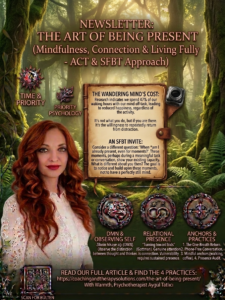
THE ART OF BEING PRESENT: MINDFULNESS, CONNECTION & LIVING FULLY (ACT and SFBT approach)

 
How often are you truly here?
Not physically present while your mind is somewhere else.
Not scrolling while listening.
Not planning tomorrow while living today.
Not replaying yesterday while missing what is happening right in front of you.
Just here.
If you’re like most people, being fully present can feel surprisingly difficult. Modern life constantly pulls our attention away from the moments we are actually living. Our minds jump ahead, look back, solve problems, imagine conversations, rehearse worries, and revisit old stories.
And yet, beneath all the noise, there is often a quiet longing.
A longing to feel more connected.
More alive.
More engaged with the people we love.
More present for our own lives.
If that longing feels familiar
You do not need to become a different person to experience more presence.
You do not need to silence your thoughts.
You do not need to walk mindfully perfectly.
You just need to learn how to return.
Again and again.
And again.
The Human Mind Was Never Designed to Stay Still
One of the most fascinating studies on attention was conducted by psychologists Matthew Killingsworth and Daniel Gilbert.
Their research found that people spend approximately 47% of their waking hours thinking about something other than what they are currently doing.
Nearly half of life is spent somewhere else.
More importantly, they discovered that mind-wandering was associated with lower levels of happiness regardless of the activity people were engaged in.
The strongest predictor of happiness was not what people were doing.
It was whether they were mentally present while doing it.
This  suggests that the quality of our lives is not determined solely by our circumstances.
It is also shaped by our relationship with this moment.
Yet many people hear this research and immediately become self-critical.
“My mind wanders constantly.”
“I can never stay present.”
“I’m terrible at mindfulness.”
But perhaps there is a gentler question to ask:
When are you already present?
Because the truth is, presence is probably happening more often than you realize.
Perhaps it appears when you’re listening carefully to someone you love.
When you’re immersed in a meaningful project.
When you’re reading about a subject that fascinates you.
When you’re walking through nature.
When you’re laughing with a friend.
When you’re drinking your morning coffee and, for just a few moments, there is nowhere else you need to be.
These moments matter.
They are evidence.
Evidence that presence is already part of who you are.
The goal is not perfection.
The goal is noticing what is already working and creating more opportunities for it.
Why Presence Matters More Than We Think
The cost of distraction is not simply reduced productivity.
The deeper cost is disconnection.
Disconnection from ourselves.
Disconnection from others.
Disconnection from life itself.
Researcher Sherry Turkle found something remarkable in her studies on conversation and technology.
The mere presence of a smartphone on the table—even when it is silent and face down—reduces the depth and quality of conversation.
Why?
Because people unconsciously anticipate interruption.
Without realizing it, they keep conversations at a level that can survive being interrupted.
The vulnerable conversations.
The meaningful conversations.
The moments of genuine emotional connection.
Those become less likely.
Attention has become one of the most valuable and contested resources in modern life.
Yet relationships thrive on attention.
The simple act of fully turning toward another human being remains one of the greatest gifts we can offer.
One of the biggest misconceptions about mindfulness is that presence means never getting distracted.
It doesn’t.
The mind wanders.
That is what minds do.
The practice is not preventing wandering.
The practice is returning.
Your attention drifts.
You notice.
You come back.
It drifts again.
You notice.
You return again.
Each return is an act of awareness.
Each return is a moment of connection.
Each return strengthens your ability to live intentionally.
If your mind wanders one hundred times today and one hundred times you gently return, that is not failure.
That is mindfulness.
What Is Happening in the Brain?
Neuroscientists have identified a network in the brain known as the Default Mode Network (DMN).
This network becomes active when our minds drift into self-focused thinking, future planning, remembering the past, and internal storytelling.
The DMN itself is not a problem.
In fact, it contributes to creativity, imagination, reflection, empathy, and planning.
The challenge arises when we become trapped there.
When the mind rarely rests in the present.
When worrying about the future becomes chronic.
When replaying the past becomes endless.
When mental noise becomes the background soundtrack of life.
Research has linked excessive, uncontrolled DMN activity with anxiety, depression, rumination, and reduced life satisfaction.
This is where mindfulness becomes powerful.
Not because it eliminates thinking.
But because it changes our relationship with thoughts.
Instead of becoming completely absorbed in every story the mind creates, we begin to notice them.
“I’m noticing that my mind is worrying.”
“I’m noticing that my mind is planning.”
“I’m noticing that my mind is replaying something.”
The thought remains.
But our relationship to it changes.
We become observers rather than prisoners.
You Are Larger Than Your Thoughts
There is something profoundly freeing about recognizing that you are not every thought your mind produces.
Thoughts change.
Feelings change.
Circumstances change.
Your body changes.
Yet there is a part of you that has remained present through every chapter of your life.
The part that notices.
The part that observes.
The awareness that has witnessed every joy, every uncertainty, every success, and every transition.
From this place of awareness, we can begin to make room for difficult emotions rather than fighting them.
Anxiety can be present.
Sadness can be present.
Uncertainty can be present.
And life can still be lived.
Many people spend years waiting for discomfort to disappear before allowing themselves to fully engage with life.
But meaningful living does not begin after fear leaves.
Meaningful living begins when we choose to move toward what matters while carrying our humanity with us.
The Science of Mindfulness
Jon Kabat-Zinn defined mindfulness as:
“Paying attention, on purpose, in the present moment, non-judgmentally.”
Three simple elements:
  • Intentional attention
  • Present-moment awareness
  • Non-judgmental observation
And remarkably, this practice changes the brain.
Harvard researcher Sara Lazar found that long-term meditators showed greater cortical thickness in regions associated with attention, sensory awareness, and self-regulation.
Judson Brewer’s work demonstrated reduced activity in the Default Mode Network among experienced meditators.
Richard Davidson’s research found changes associated with greater emotional resilience, improved well-being, and reduced stress reactivity.
Even more encouraging:
Benefits begin sooner than many people expect.
Studies suggest that as little as 8–10 minutes of daily mindfulness practice can produce measurable improvements in attention and stress regulation within weeks.
You do not need years of practice before change begins.
The first benefit often appears the moment you start noticing.
A Different Kind of Question
Many people ask:
“Why can’t I stay present?”
But perhaps a more useful question is:
“What helps me stay present when it happens?”
Consider:
  • When were you recently more present?
  • What were you doing?
  • What were you paying attention to?
  • What helped make that moment possible?
  • What strengths were you drawing upon?
  • What qualities of yours showed up?
Curiosity?
Gratitude?
Compassion?
Focus?
These questions shift us away from self-criticism and toward discovery.
They help us identify what is already working.
And what is already working can grow.
The Most Important Form of Presence
While mindfulness is often discussed as a personal practice, its deepest impact may be relational.
Presence is one of the purest forms of love.
John Gottman’s research on relationships found that successful couples consistently “turn toward” one another’s bids for connection.
A question.
A comment.
A glance.
A gesture.
A moment of vulnerability.
Over time, thousands of these small moments create the architecture of trust and intimacy.
Carl Rogers, the founder of person-centered therapy, believed that one of the most healing experiences a person can have is to feel genuinely understood.
Not fixed.
Not analyzed.
Not corrected.
Simply understood.
Presence says:
“I’m here.”
“I feel you.”
“You matter.”
And perhaps the greatest gift we can offer another human being is our undivided attention.
Presence in Nature
Nature offers another pathway back to ourselves.
Researchers Rachel and Stephen Kaplan developed Attention Restoration Theory, showing that natural environments help restore depleted attention.
Beyond restoration, nature often evokes awe.
Awe invites us out of constant self-focus and into something larger.
Research by Dacher Keltner and colleagues suggests that even brief experiences of awe increase well-being, generosity, life meaning, and the feeling of having enough time.
Why standing beside the ocean can feel healing.
Why a star-filled sky can suddenly place our worries into perspective.
For a moment, we stop managing life and experience it.
Four Practices for Living More Presently
1. The One-Breath Return
Before any meaningful transition, take one conscious breath.
Before a meeting.
Before a meal.
Before answering the phone.
Before speaking with someone you love.
One breath.
One moment of arrival.
One intentional return.
2. The Phone-Free Conversation
Choose one conversation each day where your phone is completely absent.
Not nearby.
Absent.
Then tell the person:
“I want to be here with you.”
Watch what changes.
3. Create Presence Anchors
Select three ordinary moments that become opportunities for mindfulness.
Your morning coffee.
A walk.
A shower.
Preparing a meal.
Allow these moments to become reminders that life is happening now.
4. Conduct a Weekly Presence Audit
At the end of each week, ask:
  • Where was I most present?
  • Where was I most absent?
  • What was pulling me away?
  • What helped me return?
Awareness creates choice.
And choice creates change.
A Gentle Reminder Before You Go
If there is one thing I hope you carry with you after reading this, it is this:
Your life is not waiting for you somewhere in the future.
It is not hidden inside a perfect version of yourself.
It is not waiting for the day when your mind finally becomes quiet.
Your life is happening now.
In ordinary conversations.
In morning coffee.
In walks through familiar streets.
In the laughter of people you love.
In the breath you are taking at this very moment.
You only need to notice that this moment is here.
And when your mind wanders—as all minds do—you can gently come back.
Again.
And again.
And again.
Every return is an act of courage.
Every return is an act of love.
Every return is a way of saying:
“This moment matters.”
And so do I.
And so do the people I share it with.
May you give yourself permission to arrive.
Not someday.
Today.

Subscribe for monthly updates on mental health tips, therapy insights, and wellness strategies.

Stay connected with our community and receive valuable resources to support your mental health journey.

SubscriptionForm
We respect your privacy. Unsubscribe at any time.
Schedule An Appointment

Fill out the form below and I'll get back to you within 24 hours.

Appointment Form
Contact us

Maple, ON L6A

Let's Talk

Phone: +1 (365) 607-0532

Online Appointment
Psychology Today

Disclaimer

Coaching is not psychotherapy; coaching does not diagnose or treat mental health conditions. Coaching focuses on personal development, goal achievement, and mindset shifts. It is not a substitute for a serious mental health treatment, diagnosis, or psychotherapy.